









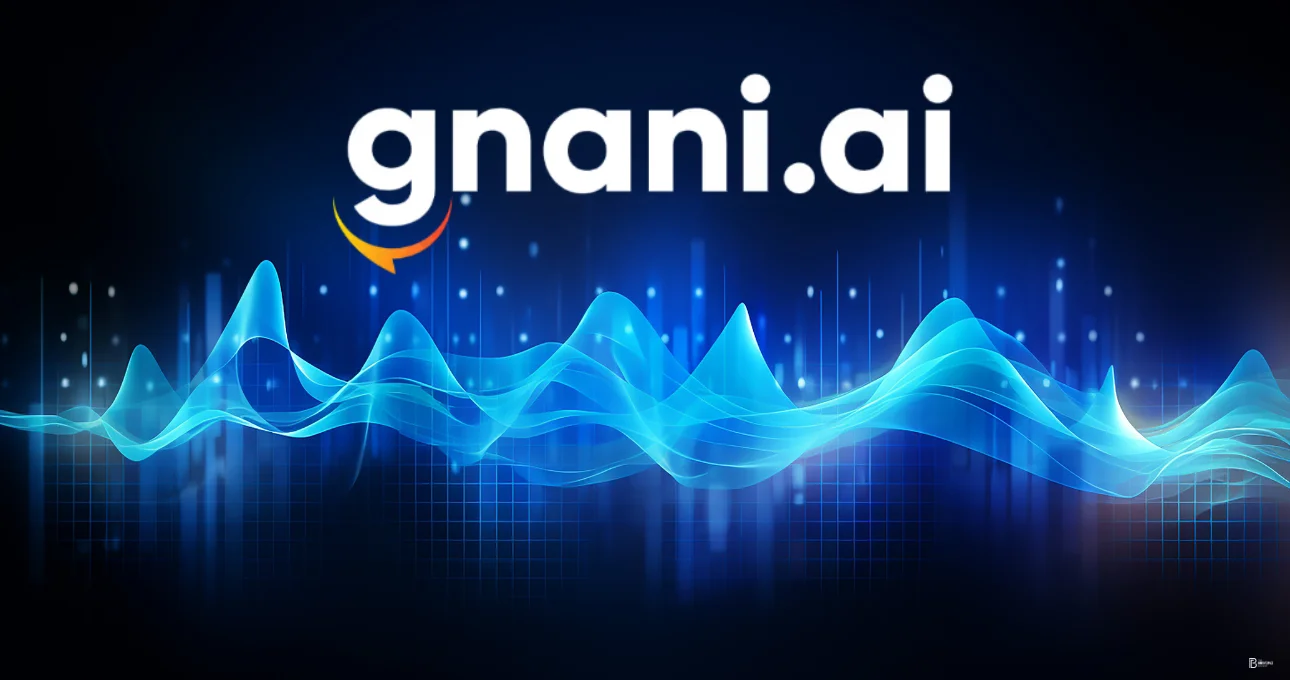
As voice AI continues to reshape customer service, healthcare, banking, and enterprise communication, one challenge remains difficult to solve: accurately understanding how people actually speak. Enterprise voice AI startup Gnani.ai is aiming to address this challenge with the launch of Prisma v2.5, its latest speech-to-text (STT) model designed to handle the complexities of multilingual and diverse conversations.
What Is Prisma v2.5?
Prisma v2.5 is a speech-to-text model that supports 12 languages and is built to recognize the realities of everyday communication. Unlike traditional speech recognition systems that often struggle outside controlled environments, the model has been designed to handle dialect variations, ambient noise, and natural code-switching. These capabilities are directly integrated into its training distribution, allowing it to better understand conversations where speakers switch between languages or communicate in varied accents.
The model is available through application programming interfaces (APIs), enabling enterprises and developers to integrate advanced speech recognition capabilities into their applications, customer support systems, and business workflows.
Trained on 14 Million Hours of Indic Speech
A key highlight of Prisma v2.5 is the scale of data behind it. According to Gnani.ai, the model has been trained on 14 million hours of proprietary Indic speech, providing it with extensive exposure to the linguistic diversity found across India.
This large training dataset allows the model to better understand regional accents, language variations, and conversational patterns that are often difficult for global speech recognition systems to capture. As businesses increasingly rely on voice-driven interactions, the ability to accurately process multilingual communication is becoming a critical requirement.
Addressing Critical Transcription Challenges
Prisma v2.5 is designed to close several transcription gaps that commonly affect speech recognition systems. The model claims to improve accuracy in areas such as short utterances, numerals, alphanumerics, named entities, and domain-specific vocabulary.
These capabilities are particularly important for industries such as banking, financial services, insurance, and healthcare, where transcription errors can lead to operational inefficiencies and compliance challenges. In sectors where customer records, policy details, account information, or medical terminology must be accurately captured, even minor mistakes can create significant downstream consequences.
By improving recognition accuracy in these critical areas, Prisma v2.5 aims to support better CRM logging, compliance workflows, and agent-assist applications while reducing the risk of costly errors.
Built for Real-World Indian Conversations
Speaking about the launch, Ganesh Gopalan, Cofounder and Chief Executive Officer of Gnani.ai, emphasized that most automatic speech recognition (ASR) models are built for ideal conditions rather than real-world usage.
According to Gopalan, Indian conversations often take place over compressed network connections, involve multiple languages within a single sentence, and feature accents that are rarely represented in traditional training datasets. Prisma v2.5 has been developed specifically to address these realities, making it more suitable for practical enterprise applications.
Why the Launch Matters
The introduction of Prisma v2.5 highlights the growing demand for AI solutions that understand local languages, accents, and communication patterns. As organizations continue investing in voice automation and conversational AI, accurate speech recognition is becoming a key factor in delivering better customer experiences and operational efficiency.
With support for multiple languages, extensive Indic speech training, and a focus on real-world communication challenges, Prisma v2.5 positions itself as a solution tailored for enterprises operating in diverse linguistic environments. The launch also reflects a broader industry trend toward developing AI systems that are trained for practical usage rather than ideal testing conditions, helping businesses unlock the full potential of voice-based technologies.