











Alibaba Expands Its AI Hardware Ambitions With the Zhenwu M890
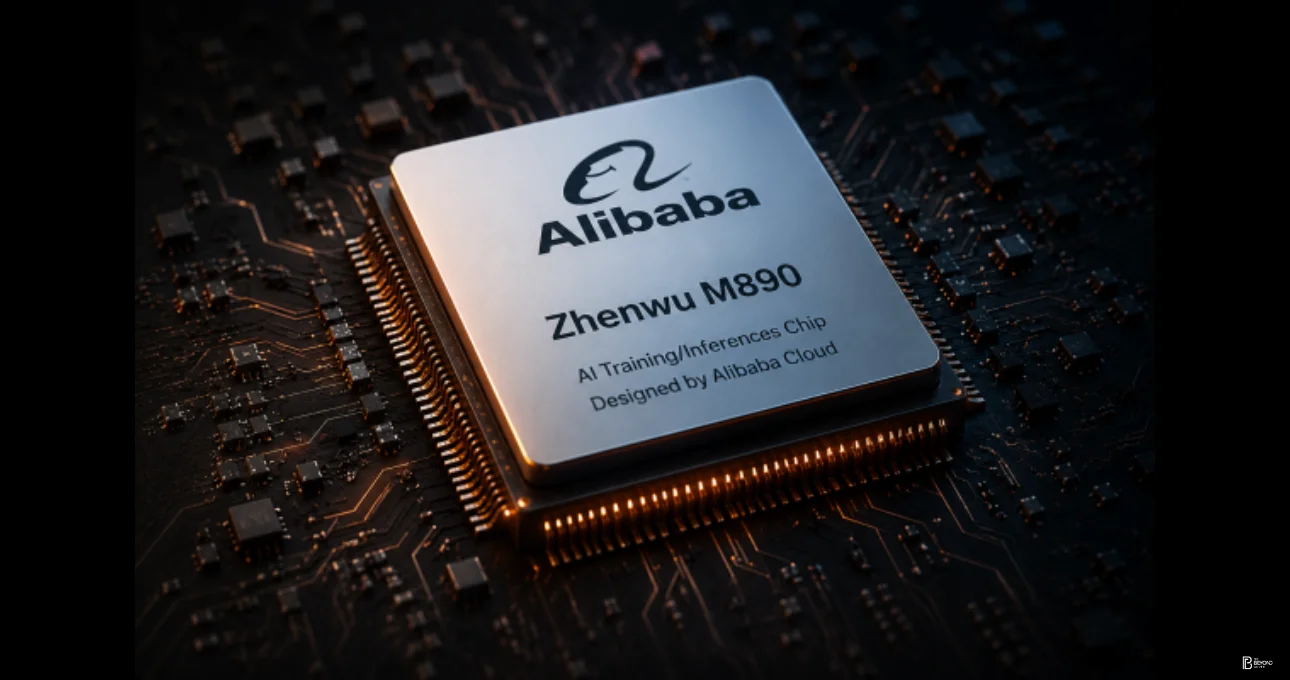
Alibaba Group has introduced the Zhenwu M890, a new AI chip designed to support autonomous AI systems and advanced enterprise workloads, marking a significant step in China’s effort to reduce dependence on foreign semiconductor technology.
Announced at the Alibaba Cloud Summit in Hangzhou, the launch comes as Chinese technology companies accelerate investments in domestic AI infrastructure amid ongoing U.S. restrictions on advanced AI chip exports.
The Zhenwu M890 is designed to handle complex, multi-step AI tasks with limited human input – an increasingly important capability as enterprises adopt AI agents for automation, coding, customer service, analytics, and operational workflows.
Built for AI Agents and High-Performance Enterprise Workloads
According to Alibaba, the Zhenwu M890 delivers three times the performance of its previous-generation chip and is optimized specifically for autonomous AI applications.
Unlike traditional AI systems that depend heavily on human prompts, modern AI agents are designed to independently execute workflows, process data continuously, and make decisions across multiple steps. These workloads require powerful infrastructure capable of managing large-scale reasoning, faster inference, and efficient data processing.
Alibaba introduced the chip alongside its Panjiu AL128 server system, which is designed to maximize AI performance through optimized cooling, power efficiency, and interconnect architecture.
Together, the hardware ecosystem aims to provide enterprises with a more integrated platform for AI-heavy computing environments.
China’s Push for AI Chip Independence Accelerates
The launch also reflects China’s broader push toward semiconductor self-reliance.
U.S. export restrictions have limited Chinese companies’ access to NVIDIA’s most advanced AI processors, including the H100 and future Blackwell series. Even reduced-performance alternatives available in China have created long-term concerns around supply chain stability and AI competitiveness.
As a result, companies like Alibaba are rapidly investing in domestic chip development to strengthen China’s AI infrastructure ecosystem.
Alibaba’s strategy aligns closely with national efforts to build independent capabilities in cloud computing, semiconductors, AI systems, and advanced manufacturing technologies.
Alibaba Builds a Complete AI Ecosystem
Alibaba’s ambitions extend beyond hardware alone.
The company also introduced Qwen 3.7-Max, its latest AI model optimized for coding and long-running AI agent tasks. The software is designed to work closely with the Zhenwu M890, creating a vertically integrated AI ecosystem where hardware and software are optimized together for better performance and efficiency.
Alibaba additionally revealed plans for future processors:
- V900, expected in 2027 for AI inference
- J900, expected in 2028 for advanced AI training workloads
The roadmap highlights Alibaba’s long-term commitment to building competitive AI infrastructure capable of supporting enterprise-scale AI adoption.
Growing Competition in China’s AI Chip Market
Alibaba now joins several major Chinese technology firms developing domestic AI processors, including Huawei, Baidu, and Tencent.
However, Alibaba’s advantage lies in the scale of Alibaba Cloud, which already supports millions of enterprise customers. This gives the company a strong foundation to deploy its AI infrastructure directly into existing cloud ecosystems.
The launch of the Zhenwu M890 signals a much larger shift happening across the global AI market. As geopolitical tensions reshape semiconductor supply chains, countries and technology companies are increasingly building independent AI ecosystems focused on long-term technological control, infrastructure resilience, and AI competitiveness.