









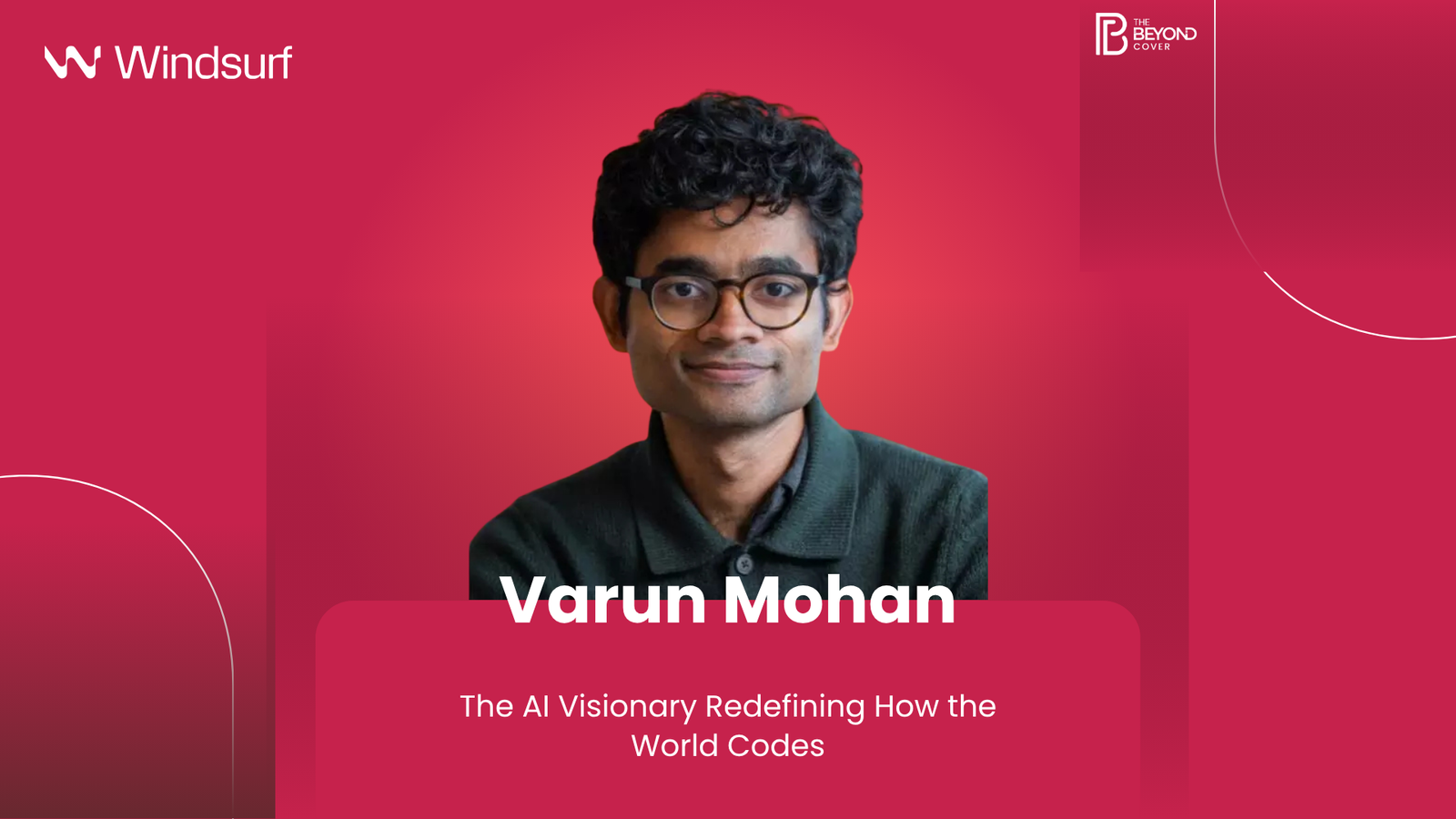
In the world of software engineering, few stories capture ambition, agility, and foresight quite like Varun Mohan’s. As the co-founder and CEO of Windsurf, he’s not just building another developer tool — he’s leading a movement to reimagine how humans and AI create software together.
From Silicon Valley Roots to MIT Innovator
Born and raised in Sunnyvale, California, to Indian immigrant parents, Varun’s fascination with technology began early — not as a pursuit of code, but of possibility. His talent for mathematics and computing led him to MIT, where he earned a dual degree in Electrical Engineering and Computer Science.
At MIT, he dived into everything from machine learning to distributed systems, while internships at LinkedIn, Quora, Samsung, and Cloudera helped him see how large-scale systems shape the modern digital world. These experiences laid the foundation for a future that would merge deep infrastructure knowledge with creative AI applications.
Engineering AI at Scale
Before launching Windsurf, Varun played a key role at Nuro, the autonomous vehicle startup pioneering self-driving delivery. Leading the autonomy infrastructure team, he faced one of the toughest challenges in modern AI — scaling deep learning models to make real-time driving decisions.
This experience sharpened his understanding of how AI systems think, learn, and evolve — and it sparked a realization: AI’s real revolution would begin when developers could harness its full potential with ease and creativity.
The Birth of Windsurf: From GPUs to Genius Coding
In 2021, Varun and his MIT classmate Douglas Chen launched what would become Windsurf (originally Codeium). The company began by solving a deeply technical problem — optimizing GPU utilization for large-scale AI workloads.
But when the generative AI wave hit with models like GPT-3.5, Varun saw something bigger. The future wasn’t just in optimizing AI — it was in empowering every developer to build with it.
That realization led to Windsurf’s bold pivot: creating an AI-native Integrated Development Environment (IDE) designed to transform how software is written, tested, and shipped.
Reimagining the Developer’s Workflow
Windsurf’s IDE doesn’t just autocomplete code — it collaborates. By embedding large language models into the development process, Windsurf acts like a co-engineer, understanding context, predicting intent, and helping developers design smarter systems, faster.
The impact was immediate: within months of its beta launch in 2022, over one million developers joined the platform. In 2024, Windsurf launched its standalone IDE, positioning itself as a category leader in AI-assisted software development.
Leadership That Thinks Beyond Limits
Varun’s leadership is guided by one principle: don’t build for the AI of today — build for the AI of tomorrow.
He believes the next generation of engineers will no longer spend time on repetitive code but instead focus on strategy, creativity, and innovation — the human side of engineering. Under his guidance, Windsurf is preparing developers for that shift, helping them work with AI as a true collaborator.
Building the Future of Coding
Today, Windsurf stands at the cutting edge of the AI revolution in software development, backed by significant funding and a fast-growing community of global developers. Its mission is simple yet transformative: to make building software as natural as thinking.
As the world of technology accelerates toward intelligent automation, Varun Mohan’s journey from a curious Silicon Valley student to a visionary AI founder is proof that the future of software isn’t just faster — it’s smarter, more human, and infinitely more creative.
In Summary
Varun Mohan represents a new generation of tech founders — engineers who think like artists, innovators who build like scientists. Through Windsurf, he’s leading the charge toward a future where AI and human creativity flow together, reshaping the way the world writes its next great ideas — one intelligent line of code at a time.