









A Major Shift in Microsoft’s AI Strategy
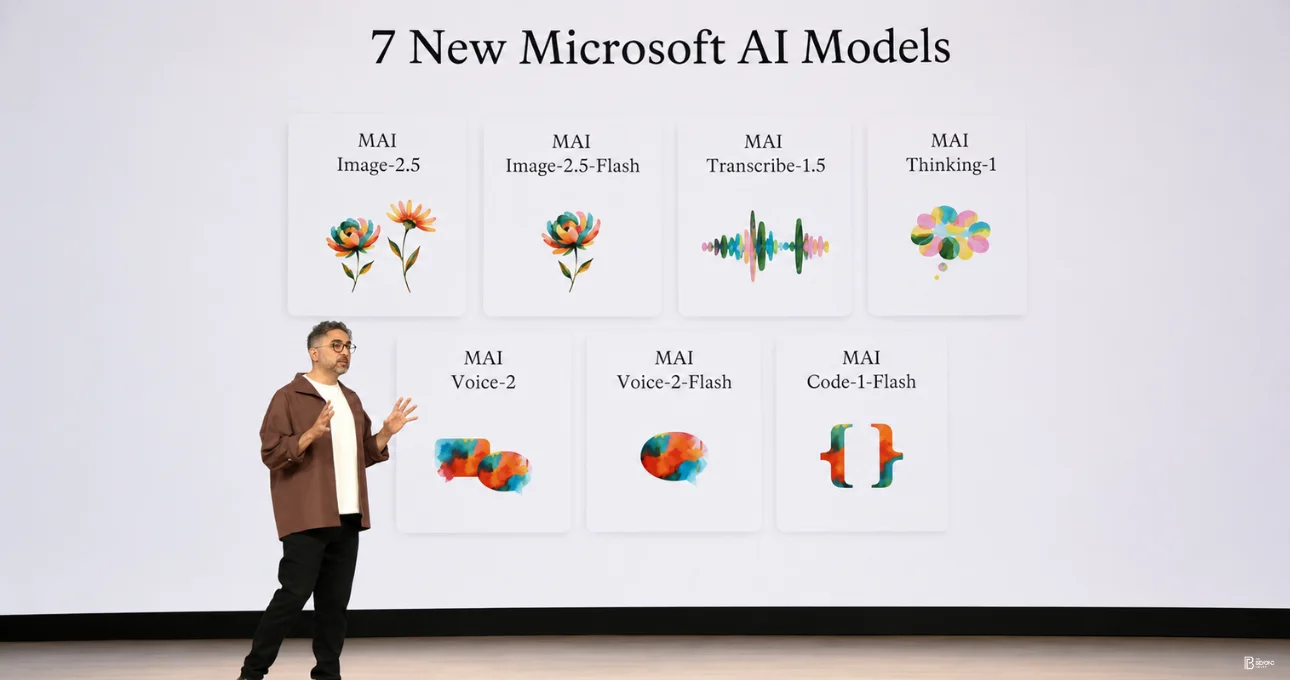
Microsoft has taken a significant step in the artificial intelligence race by building seven of its own AI models, all trained without OpenAI. This move signals a clear shift in strategy and highlights how quickly the AI landscape is evolving from dependency to independence.
For readers tracking AI trends, this is more than just a technical update – it reflects how major tech companies are rethinking control over intelligence systems, cost structures, and long-term innovation power.
Seven MAI Models Mark a New Phase of Independence
Microsoft has reportedly shipped seven internal MAI (Microsoft AI) models in a single rollout, the first major set of models developed independently since key rights were restored in April.
These models span multiple use cases, but two standout developments are already drawing attention:
- A coding model that uses around 60% fewer tokens, making it significantly more efficient and cost-effective
- An image generation model that is already ranked above Gemini on the Arena leaderboard, a widely used AI performance benchmark
Together, these improvements show that Microsoft is not just experimenting with in-house AI – it is building competitive systems designed for real-world performance and scale.
Why This Move Signals an AI “Decoupling” Moment
Microsoft has long been one of the closest and most important partners of OpenAI. However, this latest development suggests a gradual but meaningful “decoupling” between the two.
While the partnership still exists, Microsoft’s decision to train and deploy its own AI models indicates a desire to reduce dependency on a single external intelligence provider.
Instead of relying entirely on OpenAI’s models, Microsoft is now building its own foundation models – giving it more control over performance, pricing, customization, and integration across its ecosystem.
For the AI industry, this marks an important turning point: even the strongest partnerships are now evolving toward independence and diversification.
Owning Intelligence vs Renting It
At the core of Microsoft’s move is a strategic question that many companies are now facing:
Should you own your AI systems, or rent intelligence from others?
Microsoft appears to be choosing ownership.
By building internal models, the company gains:
- Greater control over AI performance and updates
- Reduced reliance on external providers
- Better cost efficiency at scale
- Flexibility to tailor models for specific products and industries
This approach reflects a broader shift in enterprise AI strategy, where intelligence is no longer just a service – but a core asset.
Efficiency Is Becoming the Real Competitive Edge
One of the most important details in Microsoft’s new models is efficiency.
The coding model reportedly achieves similar tasks using 60% fewer tokens, which directly reduces computing costs and improves speed. In large-scale AI deployment, this kind of efficiency can significantly impact both performance and profitability.
At the same time, the image model outperforming Gemini on benchmark rankings shows that efficiency is not coming at the cost of capability.
Instead, Microsoft is aiming to balance performance and optimization – two factors that will define the next phase of AI competition.
What This Means for the AI Industry
Microsoft’s decision adds new pressure across the AI ecosystem, including players like OpenAI, Google DeepMind, and others.
The message is clear: no single AI provider can assume long-term dominance.
The industry is rapidly moving toward a multi-model world, where companies use a combination of internal and external AI systems depending on cost, accuracy, and use case.
This shift will likely reshape:
- How AI products are built
- How companies choose AI providers
- How pricing models evolve
- How innovation is distributed across the industry
What It Means for Businesses and Developers
For businesses and developers building on AI, Microsoft’s move is an important signal to rethink dependency strategies.
Key takeaways include:
- Avoid relying on a single AI model provider
- Prepare for a multi-model AI ecosystem
- Focus on flexibility and modular AI architecture
- Prioritize efficiency, not just capability
As AI becomes more deeply embedded in products and services, control over intelligence infrastructure will become a key competitive advantage.
The Bigger Picture: A Shift Toward AI Ownership
Microsoft building its own AI models is not just about competition – it is about control.
Owning intelligence systems allows companies to shape their future without external limitations. It also reduces risk in a rapidly changing technological environment where partnerships, pricing, and access can shift quickly.
This development signals a broader transformation in the AI world: the era of relying on a single dominant model provider is slowly giving way to a more distributed, competitive, and diversified ecosystem.
The Bottom Line
Microsoft’s creation of seven internal AI models without OpenAI marks a major strategic shift in the AI industry. It reflects a move toward independence, efficiency, and long-term control over intelligence systems.
As the AI race intensifies, one thing becomes clear: the future will not be defined by who builds the best single model – but by who builds the most flexible and powerful AI ecosystem.