










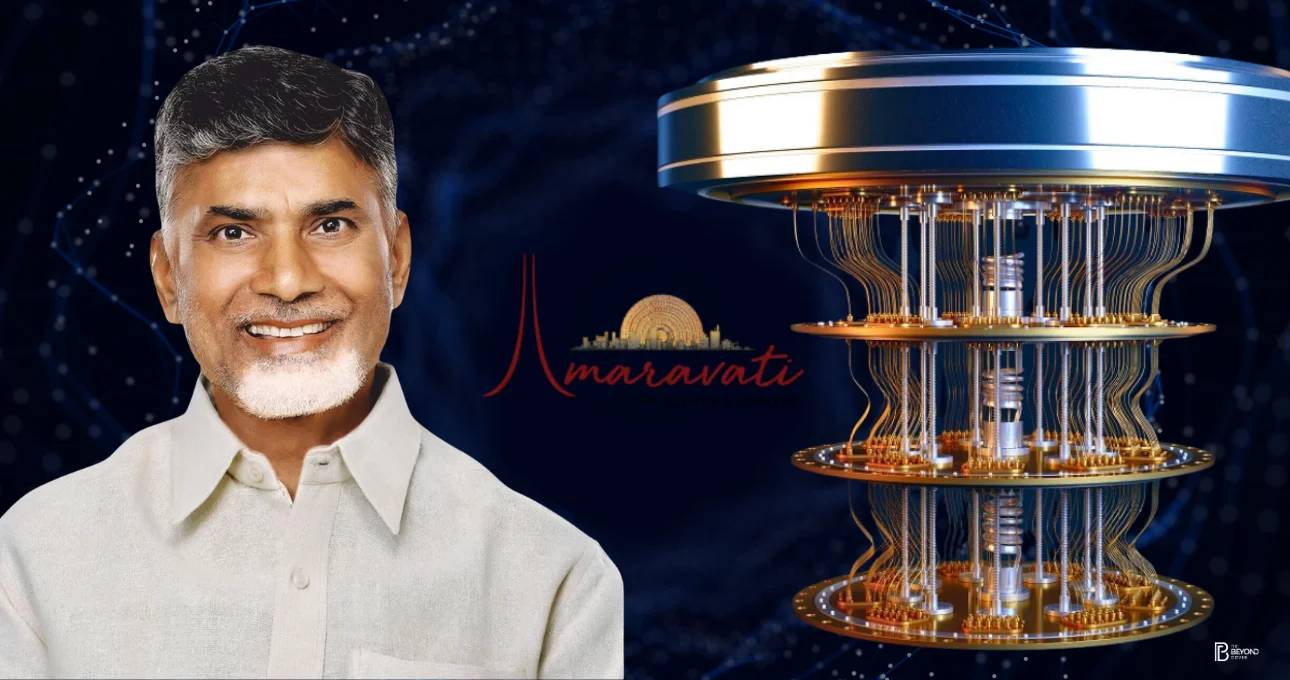
A Landmark Step in India’s Quantum Journey
In a major boost to India’s deep-tech ambitions, N. Chandrababu Naidu is inaugurating the country’s first indigenous quantum computer test facilities, positioning Amaravati as an early hub for quantum research and innovation.
With the launch of two open-access Quantum Reference Facilities–Amaravati 1Q at Medha Towers in Gannavaram and Amaravati 1S at SRM University—India takes a decisive step toward building its own quantum infrastructure under the National Quantum Mission. Timed with World Quantum Day, the initiative signals both symbolic and strategic intent: to bring quantum technology closer to real-world adoption.
These facilities operate at extreme cryogenic temperatures of minus 273°C, enabling highly precise testing and certification of quantum computing components. More importantly, they are designed as open-access platforms, allowing researchers, students, and startups to directly engage with quantum systems– making advanced technology more accessible than ever before.
Amaravati Quantum Valley: Building India’s Quantum Ecosystem
At the center of this transformation is the ambitious Amaravati Quantum Valley vision. Designed to mirror the success of global innovation clusters, it aims to bring together research institutions, startups, manufacturers, and skilled professionals into a single, thriving ecosystem.
The Andhra Pradesh government has already allocated 50 acres for the Amaravati Quantum Computing Centre, where advanced systems– including a 133-qubit quantum computer from IBM and installations from QpiAI– are planned. The state is also targeting local quantum computer manufacturing within the next two years, supported by an enthusiastic response to its quantum skilling program, which has already attracted around 50,000 students.
This vision goes beyond infrastructure– it is about creating a complete pipeline from research to real-world application.
Strengthening India’s Quantum Infrastructure
The Amaravati 1Q and 1S facilities address long-standing gaps in India’s quantum ecosystem. By enabling hardware validation under cryogenic conditions, component certification, and startup incubation through subsidized access, they lay the groundwork for sustained innovation.
The collaboration with SRM University further strengthens academic-industry linkages, ensuring that theoretical research translates into practical solutions. Partnerships with organizations like Tata Consultancy Services and Larsen & Toubro add an industrial dimension, with plans to test over 100 quantum algorithms in the near future.
Inside these labs, systems operate at near absolute zero temperatures–conditions essential for maintaining qubit stability and enabling quantum phenomena such as superposition, which are fundamental to quantum computing.

Aligning with the National Quantum Mission
Amaravati’s emergence as a quantum hub aligns closely with India’s broader goals under the National Quantum Mission, backed by a ₹6,000 crore investment to drive leadership in quantum computing, communication, and sensing by 2030.
While cities like Bengaluru and Hyderabad have traditionally led India’s technology growth, Amaravati is carving out a niche in the next frontier of computing. By addressing the infrastructure gap, it enables researchers and enterprises to move beyond experimentation toward scalable, real-world applications.
This momentum also complements advancements in related fields such as artificial intelligence, secure computing, and data processing, where quantum capabilities are expected to play a transformative role.
Economic Impact and Talent Development
The Quantum Valley initiative is not just about technology– it is also about economic growth and workforce development. By building a deep-tech ecosystem, Andhra Pradesh is positioning itself to attract investments, generate high-value jobs, and create a robust supply chain around quantum technologies.
The presence of SRM University’s Quantum Research Centre ensures a steady pipeline of skilled professionals trained in advanced areas like quantum algorithms, error correction, and hybrid systems. This growing talent pool will be critical in supporting both domestic innovation and global collaborations.
Amaravati on the Global Quantum Map
With this launch, Amaravati joins an elite group of global quantum hubs, including leading research centers in the United States and China. However, its open-access approach sets it apart, encouraging broader participation and faster innovation compared to closed, proprietary models.
This inclusive strategy reflects a larger shift toward democratizing advanced technologies, ensuring that innovation is not limited to a few organizations but shared across a wider ecosystem.
Final Thoughts
The inauguration of India’s first indigenous quantum test facilities marks a defining moment in the country’s technological journey. By combining infrastructure, policy support, and talent development, Andhra Pradesh is creating a strong foundation for future breakthroughs.
As quantum computing moves from theory to application, Amaravati is rapidly transforming into a hub of possibility– where innovation, collaboration, and ambition come together to shape the future of technology.