









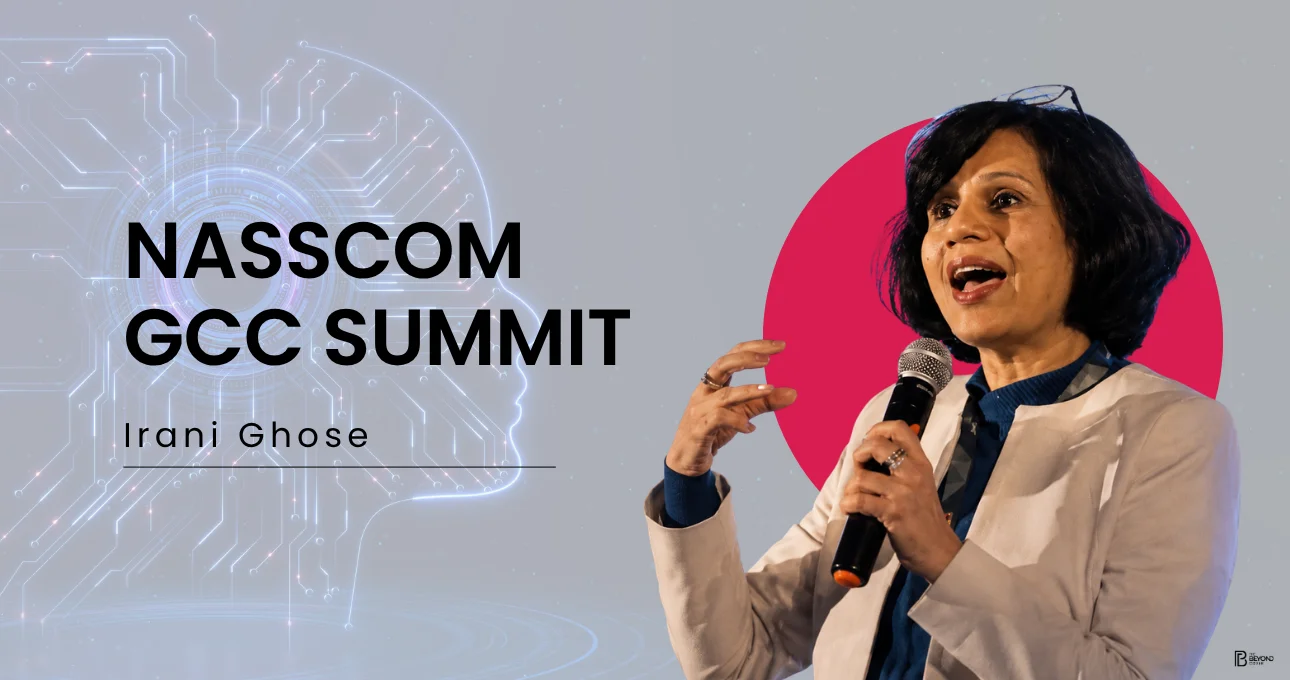
At the Nasscom GCC Summit, Anthropic India’s Irina Ghose explained why enterprises should focus less on replacing people with AI and more on defining where AI should stop.
Artificial intelligence is everywhere right now. From customer support bots and coding copilots to enterprise automation systems and AI-driven analytics, companies across the world are racing to integrate AI into their daily operations.
But while the world continues debating whether AI will replace millions of jobs, Irina Ghose, Managing Director of Anthropic India, offered a far more balanced and realistic perspective at the Nasscom GCC Confluence Summit in Bengaluru.
Her message was simple yet powerful: AI is becoming more useful, but not necessarily more universal.
Speaking to leaders from India’s growing Global Capability Center (GCC) ecosystem, Ghose said the real challenge for enterprises is no longer understanding what AI can do. Instead, companies now need to define what AI should not do.
“The list of tasks AI can handle is shrinking at a reasonable pace,” she said during the summit, challenging the widespread belief that artificial intelligence will eventually dominate every aspect of work.
The statement stood out because it shifted the conversation away from hype and toward practical reality.
AI Is Getting Smarter – But Also More Specialized
For the last few years, the AI industry has largely been driven by bold predictions. Every new launch promised faster automation, fewer human dependencies, and more autonomous systems.
But inside enterprises, the reality is turning out to be more layered.
Companies are discovering that AI performs brilliantly in structured, repetitive, and data-heavy environments. However, when situations become uncertain, emotional, strategic, or relationship-driven, human intervention still becomes critical.
That’s exactly what Ghose highlighted during her keynote.
AI can process patterns at scale. It can analyze huge volumes of information within seconds. It can generate reports, optimize workflows, write code, and automate repetitive operations.
But there are still areas where humans remain irreplaceable.
Especially when it comes to:
- Strategic decision-making
- Ethical judgment
- Client trust
- Leadership communication
- Crisis management
- Relationship building
- Handling completely unknown scenarios
This is why Ghose believes enterprises should stop looking at AI as a total replacement system and start viewing it as a specialized tool that works best within carefully defined boundaries.
Why “AI Boundaries” Are Becoming the Biggest Enterprise Priority
One of the strongest themes from Ghose’s address was the idea of boundary-setting.
According to her, businesses are spending too much time asking what AI is capable of and too little time deciding where human oversight must remain permanent.
That distinction is becoming increasingly important as AI moves deeper into sectors like finance, healthcare, consulting, public infrastructure, and enterprise services.
In many of these industries, trust matters just as much as efficiency.
And trust is something AI still struggles to build independently.
“Practitioner’s trust always comes in the way relationships get built,” Ghose noted, emphasizing that human expertise and contextual understanding continue to shape enterprise relationships.
This is especially true in industries where decisions impact people directly.
A machine may provide recommendations, but clients still look toward humans for accountability, reassurance, empathy, and long-term guidance.
That human layer cannot simply be automated away.
Enterprises Are Finally Moving Beyond AI Hype
The timing of Ghose’s comments is important.
Over the last two years, the AI industry has witnessed explosive investment and adoption. Enterprises rushed to experiment with generative AI systems, automation tools, and AI copilots across departments.
But many companies are now learning that scaling AI inside real-world business environments is much harder than early demos suggested.
Several enterprise AI pilots continue to struggle with:
- Governance issues
- Workflow integration
- Compliance concerns
- ROI measurement
- Employee adaptation
- Data privacy challenges
- Quality inconsistencies
This growing gap between AI excitement and operational reality is forcing companies to rethink how they deploy AI at scale.
And according to Ghose, the answer is not unlimited automation.
It is disciplined implementation.
AI Handles Patterns Well – Humans Handle the Unknown
One of the most interesting insights from the Nasscom GCC Summit was Ghose’s distinction between “knowns” and “unknowns.”
AI works exceptionally well when it operates inside predictable systems.
For example:
Areas Where AI Performs Strongly
- Coding assistance
- Workflow automation
- Data analysis
- Supply chain optimization
- Predictive planning
- Customer support systems
- Enterprise search and retrieval
In these cases, AI thrives because patterns already exist.
But businesses rarely operate only inside predictable conditions.
Markets change unexpectedly. Customer behavior shifts suddenly. Regulations evolve. Crises emerge without warning. Human emotions influence decisions in ways machines cannot fully interpret.
This is where AI begins to struggle.
And this is where human judgment still dominates.
Ghose argued that the future enterprise model will depend on a strong balance between AI efficiency and human intelligence.
Not replacement. Collaboration.
India Is Quietly Becoming One of the World’s Biggest AI Economies
During her address, Ghose also highlighted India’s growing position in the global AI ecosystem.
India is now considered the second-largest cloud and AI user base after the United States – a significant milestone in the country’s technology evolution.
This growth is being driven by several major factors.
Massive Technical Talent Pool
India continues to produce one of the world’s largest engineering workforces, giving enterprises access to deep technical expertise at scale.
Rapid GCC Expansion
Global Capability Centers are no longer operating as back-office support hubs alone.
Today, many GCCs are becoming innovation engines responsible for AI deployment, enterprise analytics, automation systems, and digital transformation initiatives.
India currently hosts more than 1,700 GCCs employing nearly 1.9 million professionals.
Sovereign AI Push
India is also accelerating investments in sovereign AI infrastructure and local AI ecosystems designed to support regional languages, national compliance needs, and enterprise-grade deployment.
Large-Scale Digital Adoption
India’s massive digital user base creates enormous opportunities for training and scaling AI systems across sectors.
Together, these factors are positioning India as one of the most influential players in the next phase of enterprise AI growth.
GCCs Are Becoming the Face of Enterprise AI Transformation
The Nasscom GCC Confluence Summit itself reflects how quickly India’s enterprise technology ecosystem is evolving.
Earlier, GCCs were primarily viewed as operational support centers for global companies.
Today, they are leading strategic transformation.
Many enterprises are now using India-based GCCs to drive:
- AI engineering
- Generative AI workflows
- Intelligent automation
- Enterprise copilots
- Predictive analytics
- Digital operations
- AI-led customer systems
However, scaling these systems successfully requires more than just advanced technology.
It requires organizational readiness.
Ghose stressed that companies must focus equally on:
- Upskilling employees
- Building governance frameworks
- Creating trust-first AI cultures
- Defining accountability systems
- Establishing human oversight mechanisms
Without these elements, AI deployments often fail to move beyond experimentation.
The Future Is Human-AI Symbiosis
One of the clearest takeaways from Ghose’s address was that the future of work will not belong entirely to humans or entirely to machines.
Instead, it will belong to organizations that understand how both can work together effectively.
In this emerging enterprise model:
- AI manages scale and computation
- Humans provide context and judgment
- AI accelerates productivity
- Humans build trust and relationships
- AI handles repetitive complexity
- Humans navigate ambiguity and uncertainty
This balance could become one of the biggest competitive differentiators for businesses over the next decade.
Companies that rely blindly on automation may face trust issues, governance failures, and operational risks.
Meanwhile, organizations that combine AI capabilities with strong human leadership are more likely to create sustainable long-term growth.
Why AI Governance Is Becoming a Boardroom Discussion
As AI systems become deeply integrated into enterprise operations, governance is quickly moving from IT departments to boardroom agendas.
Executives are now being forced to answer difficult questions:
- How much autonomy should AI systems receive?
- Where should human approval become mandatory?
- Who remains accountable when AI makes mistakes?
- How should companies manage AI risk?
- What ethical boundaries should enterprises establish?
These are no longer theoretical conversations.
They are becoming operational business priorities.
Ghose’s emphasis on “AI boundaries” reflects this broader shift toward responsible AI deployment.
And for enterprises moving aggressively into AI adoption, governance may soon become just as important as innovation itself.
India’s Biggest AI Advantage May Be Human Expertise
For years, India’s technology industry was associated mainly with outsourcing and cost efficiency.
But the AI era is reshaping that image rapidly.
Today, India combines:
- Engineering scale
- Enterprise AI capability
- Sovereign AI ambitions
- Massive digital infrastructure
- GCC-driven innovation
- Multilingual AI potential
This creates an opportunity far larger than cost advantage alone.
India now has the potential to become one of the world’s leading architects of enterprise AI implementation.
But according to Ghose, that leadership will depend on maintaining a healthy balance between automation and human intelligence.
Human Judgment Still Defines the AI Era
Irina Ghose’s message at the Nasscom GCC Summit delivered something the global AI conversation often lacks – realism.
Yes, AI is transforming industries at extraordinary speed.
Yes, automation will continue reshaping workflows and productivity models.
But the future may not belong to companies trying to remove humans from every process.
Instead, it may belong to organizations that understand exactly where human expertise becomes most valuable.
AI can optimize systems.
Humans still define meaning, trust, relationships, and judgment.
And in a world increasingly driven by algorithms, that human edge may become more important than ever.