










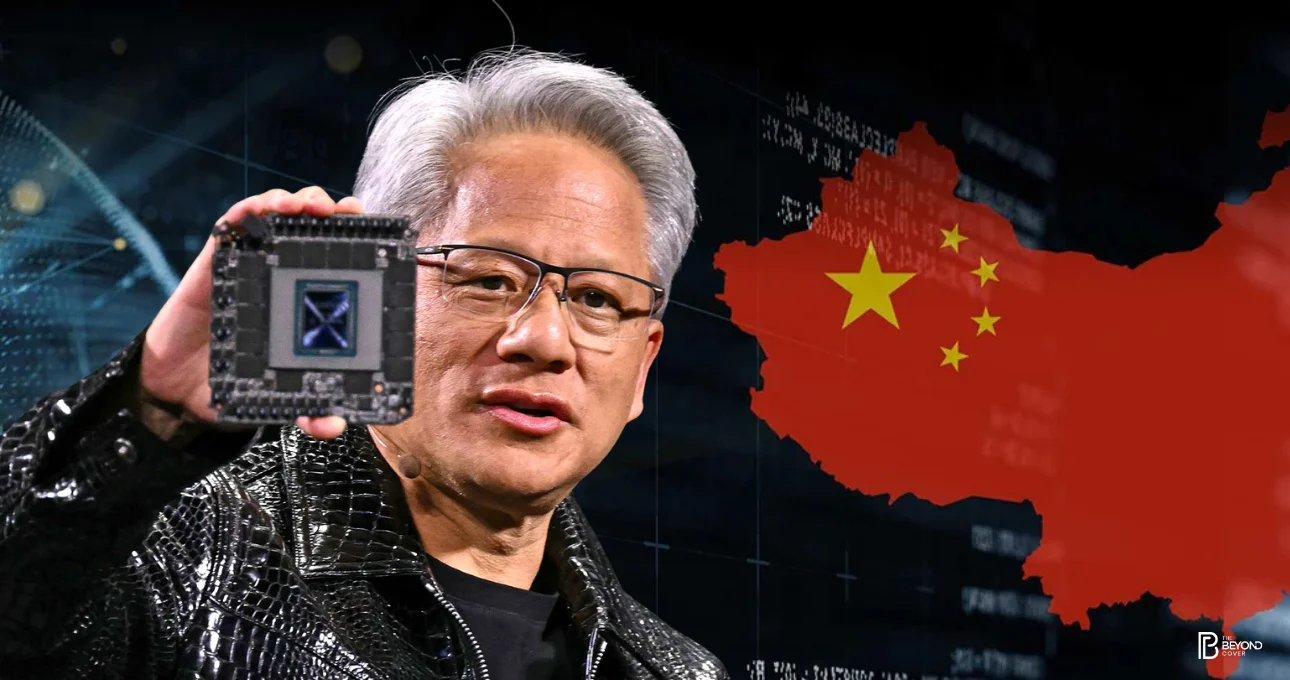
China has reportedly approved major technology companies to purchase Nvidia’s advanced H200 artificial intelligence (AI) chips, signaling a pragmatic policy shift amid the ongoing global race for AI leadership. This development highlights the complex balance Beijing is trying to strike between achieving long-term national self-reliance in semiconductors and addressing immediate performance needs for cutting-edge AI development.
China’s H200 Approval: What’s Happening?
According to multiple reports, Chinese regulators have given the green light for firms including ByteDance, Alibaba and Tencent to import more than 400,000 units of Nvidia’s H200 AI chips — among the most capable GPUs currently available for generative AI training and inference. This decision comes amid weeks of regulatory uncertainty over whether Beijing would permit the chips to enter the domestic market.
The H200, designed by Nvidia for data-center-scale AI workloads, offers significantly higher performance compared with earlier restricted models such as the H20. For Chinese AI developers racing to build and train large-scale models, access to H200 chips can help accelerate research and deployment timelines.
A Strategic Balancing Act
Beijing’s approval of H200 imports reflects a pragmatic recalibration of its semiconductor strategy. On one hand, China continues to prioritize the growth of its domestic chip industry — investing heavily in home-grown AI chips like those from Huawei, Cambricon and Alibaba-designed accelerators. On the other hand, the immediate performance advantages of Nvidia’s H200 chips have proven difficult to replicate domestically at scale.
Chinese policymakers face a tension between two key goals: achieving self-sufficiency in semiconductors and ensuring that local AI capabilities remain competitive in the near term. Allowing imports of the H200 helps address the short-term demand for high-performance compute while Chinese firms continue to develop indigenous solutions.
Moreover, the approvals reportedly come with certain conditions and restrictions that are still being finalized. Some companies have not yet converted approvals into confirmed orders, as regulatory terms and domestic industry requirements continue to be negotiated.
What It Means for Chinese Tech Giants
For China’s top internet and technology companies, access to Nvidia’s H200 chips can have a direct impact on competitive positioning. Advanced AI models — particularly large language models (LLMs) and generative AI systems — demand substantial computing power for both training and inference. Nvidia’s GPUs have long been considered the industry standard in these demanding environments.
By securing the ability to purchase H200 chips, Chinese firms gain access to a performance tier that is currently difficult to achieve with domestic equivalents alone. This can help sustain progress in AI research, development, and commercial deployment.
Domestic Alternatives Still Evolving
Despite this approval, China’s ambitions for semiconductor independence remain firmly in place. Indigenous AI chips — such as those developed by Huawei and other local players — continue to advance, albeit with performance gaps relative to Nvidia’s most powerful hardware. Analysts note that the H200’s performance significantly outpaces many domestic solutions, making it a compelling choice for high-intensity AI workloads even as China works to close the performance gap over time.
Chinese policymakers may also require firms to pair H200 imports with domestic chip purchases under certain conditions, a mechanism that could help channel investment into local semiconductor ecosystems.
Implications for U.S.-China Tech Relations
The move has broader implications for U.S.-China technology policy and geopolitics. It follows recent U.S. decisions to ease certain export controls on advanced AI chips such as the H200, which itself represented a shift from earlier restrictions aimed at limiting Chinese access to cutting-edge semiconductor technology. However, even with U.S. approval for exports, Chinese authorities had previously hesitated to permit shipments — underscoring the delicate policy balancing act in play.
The approval of H200 chip purchases suggests a recognition by Chinese regulators that short-term technological competitiveness cannot be sacrificed entirely in pursuit of long-term self-reliance goals. At the same time, both countries continue to navigate the economic and security dimensions of semiconductor trade.
What Comes Next?
As China implements the approvals and finalizes terms, attention will likely turn to how quickly these chips are integrated into AI development pipelines, and whether the conditions attached to their import will shape future procurement behavior.
Ultimately, access to Nvidia’s H200 chips provides Chinese AI developers with an important performance boost — but it also highlights the ongoing complexities of semiconductor policy in an increasingly competitive global landscape.