










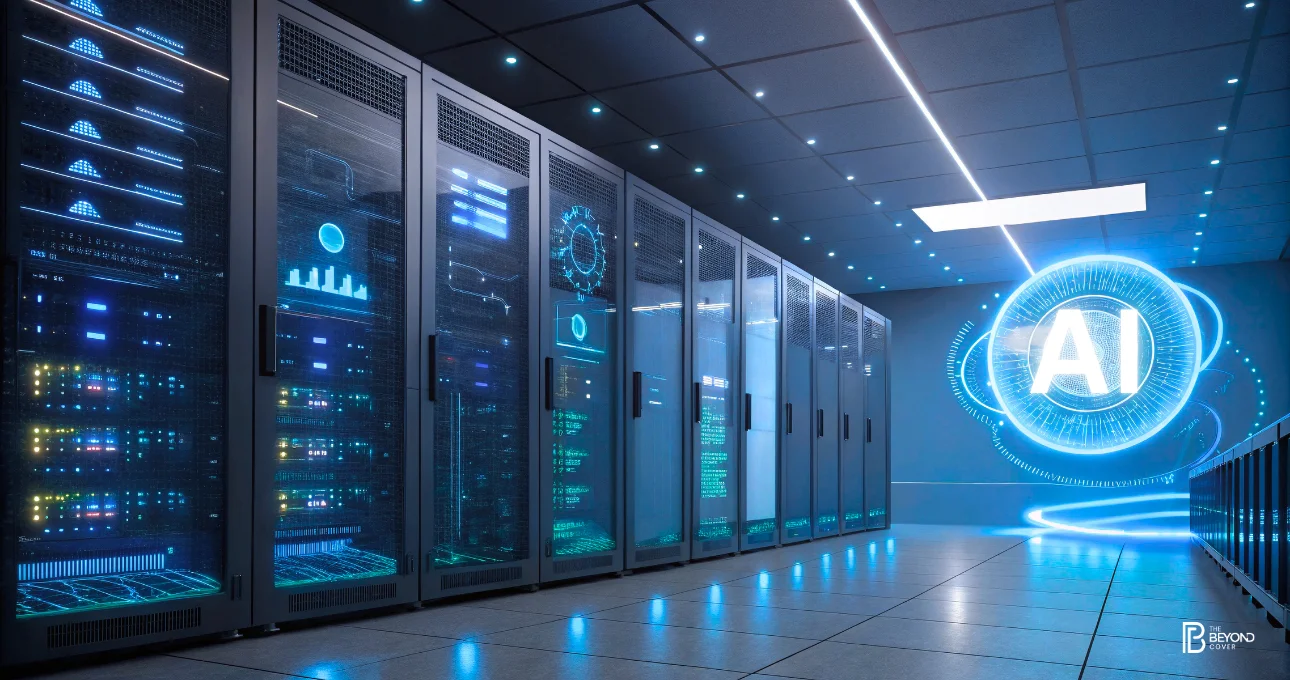
The rapid rise of artificial intelligence is transforming the world’s digital backbone. As AI workloads grow larger and more power-hungry, companies are shifting toward high-density, AI-ready data centres designed to handle extreme computing demands. This evolution marks a fundamental change in how data centre infrastructure is planned, built, and operated.
Traditional data centres were designed for enterprise IT workloads such as email, databases, and web hosting. AI has rewritten those assumptions. Training and running large AI models now requires racks packed with GPUs, high-speed interconnects, and advanced cooling systems, pushing data centres to new limits.
What Defines an AI-Ready Data Centre
High-density, AI-ready data centres are built to support rack power densities of 30 kilowatts or more, far exceeding conventional facilities that typically operate in the 5–10 kilowatt range. These facilities are optimized for GPU clusters, specialized accelerators, and low-latency networking.
Cooling is one of the most critical challenges. Air cooling alone is often insufficient for dense AI workloads, leading operators to adopt liquid cooling, direct-to-chip cooling, and immersion cooling. These technologies improve thermal efficiency and enable stable performance under heavy loads.
Power infrastructure is another key factor. AI-ready data centres require robust electrical capacity, redundancy, and access to reliable energy sources. Many operators are investing in on-site substations and exploring renewable energy to offset rising power consumption.
AI Is Driving Demand for Density
The shift toward high-density data centres is being fueled by the explosive growth of generative AI, machine learning, and real-time inference. Companies across sectors—from cloud providers and semiconductor firms to financial services and healthcare—are deploying AI models that demand immense computational throughput.
Cloud hyperscalers are leading the transition, building massive AI-focused campuses to support internal models and customer workloads. Colocation providers are also upgrading facilities to attract AI-driven enterprises that need scalable infrastructure without building their own data centres.
Operational and Sustainability Challenges
While high-density data centres unlock performance gains, they also introduce operational complexity. Managing heat, power spikes, and hardware reliability requires advanced monitoring and AI-driven management tools.
Sustainability is a growing concern. Data centres already account for a significant share of global electricity consumption, and AI is intensifying that footprint. In response, operators are investing in energy-efficient designs, waste heat recovery, and water-saving cooling systems.
Regulators and local communities are also paying closer attention to data centre expansion, particularly in regions facing water or energy constraints.
Strategic Implications for the Tech Industry
The move toward AI-ready data centres is reshaping the competitive landscape. Companies with access to advanced infrastructure gain a significant advantage in AI development and deployment. As a result, infrastructure has become a strategic asset, not just a backend utility.
For enterprises, the shift raises important decisions: whether to rely on hyperscalers, colocation providers, or build custom AI facilities. Each option comes with trade-offs in cost, control, and scalability.
Looking Ahead
Experts expect high-density, AI-ready data centres to become the new standard over the next decade. As AI models grow more complex and real-time applications expand, demand for dense, efficient infrastructure will only increase.
The transformation of data centres reflects a broader truth about the AI era: intelligence now depends as much on physical infrastructure as on algorithms. Those who invest early in AI-ready facilities will be best positioned to lead the next wave of technological innovation.