









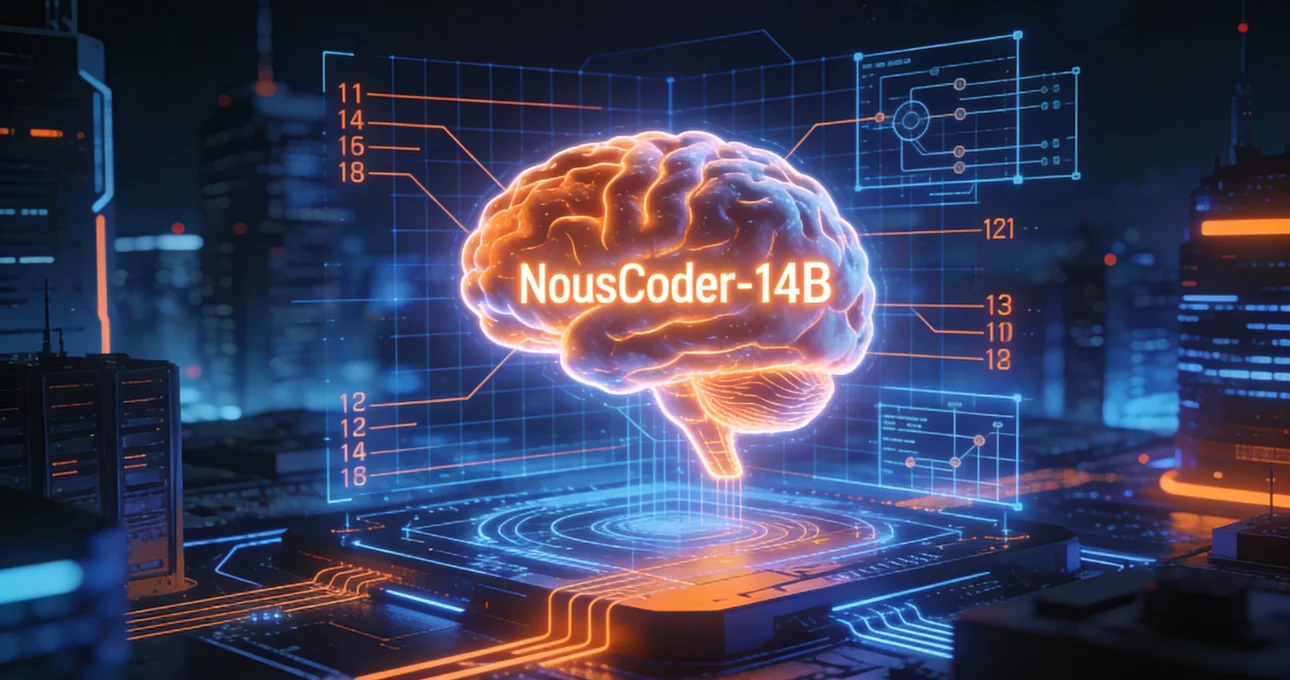
Open-source AI is gaining fresh momentum as Nous Research launches NousCoder-14B, a powerful new coding-focused language model designed to compete in an era increasingly dominated by proprietary developer tools. Released during heightened attention around Claude Code and other commercial coding assistants, NousCoder-14B positions itself as a transparent, community-driven alternative for software development teams and independent builders.
The launch reflects a broader shift in the AI landscape: developers are no longer choosing models based on raw parameter counts alone. Instead, they are prioritizing code quality, controllability, and openness, especially as AI becomes deeply embedded in production workflows.
A Coding Model Built for Real Developers
NousCoder-14B is a specialized large language model optimized specifically for programming tasks. Trained on a diverse mix of open-source code repositories, technical documentation, and structured problem-solving datasets, the model is designed to handle code generation, refactoring, debugging, and reasoning across multiple programming languages.
Unlike general-purpose models, NousCoder-14B focuses on developer ergonomics. Early descriptions emphasize cleaner code output, improved instruction-following, and stronger contextual understanding within larger codebases. This makes it suitable not only for quick snippets, but also for longer, multi-file development workflows where consistency and logic matter.
At 14 billion parameters, the model strikes a balance between capability and efficiency. It is large enough to deliver strong reasoning performance, yet small enough to be deployed on modern enterprise infrastructure without the extreme compute costs associated with frontier-scale models.
Timing the Release Amid Proprietary Momentum
The timing of NousCoder-14B’s release is notable. With proprietary coding assistants gaining traction—often bundled into closed platforms—many developers have expressed concern about lock-in, data usage, and limited customization.
Nous Research appears to be responding directly to that sentiment. By releasing NousCoder-14B as an open-source model, the organization is reinforcing the idea that cutting-edge coding AI does not have to be closed or centralized.
This approach resonates particularly with enterprises and startups that want control over their AI stack. Open-source models allow teams to fine-tune, audit, and deploy systems in compliance-sensitive environments—something that remains difficult with black-box APIs.
Why Open-Source Coding Models Matter
Coding assistants are rapidly becoming foundational tools across the software industry. They influence how applications are built, maintained, and secured. In this context, open-source coding models play a critical role.
First, they promote transparency. Developers can inspect training methodologies, evaluate biases, and understand how outputs are generated. Second, they enable customization. Teams can fine-tune models for domain-specific languages, internal frameworks, or legacy systems. Third, they reduce dependency risks by giving organizations ownership over their AI tooling.
NousCoder-14B fits squarely into this philosophy, offering a flexible alternative for teams that want AI-powered development without surrendering control.
Performance Focus Without Excessive Compute
Another key theme of the release is efficiency. As AI adoption scales, compute costs are becoming a real constraint. Models that deliver strong performance at moderate sizes are increasingly attractive.
By focusing on optimized training rather than sheer scale, Nous Research is aligning with a growing industry trend: smarter models over bigger models. This makes NousCoder-14B appealing for cloud deployments, on-premise setups, and even advanced edge environments where resources are limited.
The Broader Impact on the AI Coding Landscape
The introduction of NousCoder-14B adds competitive pressure to both open and closed ecosystems. It demonstrates that innovation in coding AI is not exclusive to tech giants or heavily funded labs. Community-driven research groups can still push meaningful advancements—especially when they focus on developer needs rather than marketing narratives.
For developers, this means more choice. For enterprises, it means more leverage. And for the AI industry as a whole, it reinforces the idea that open-source remains a powerful force in shaping the future of software development.
Conclusion: A Statement for Open AI Development
NousCoder-14B is more than just another coding model release. It is a statement about where AI-assisted software development is headed—and who gets to shape it.
By launching an open, capable, and efficient coding model at a moment dominated by proprietary tools, Nous Research is reminding the industry that openness and performance are not mutually exclusive. As AI becomes inseparable from how code is written, models like NousCoder-14B ensure that developers retain choice, control, and transparency in the tools they rely on every day.