










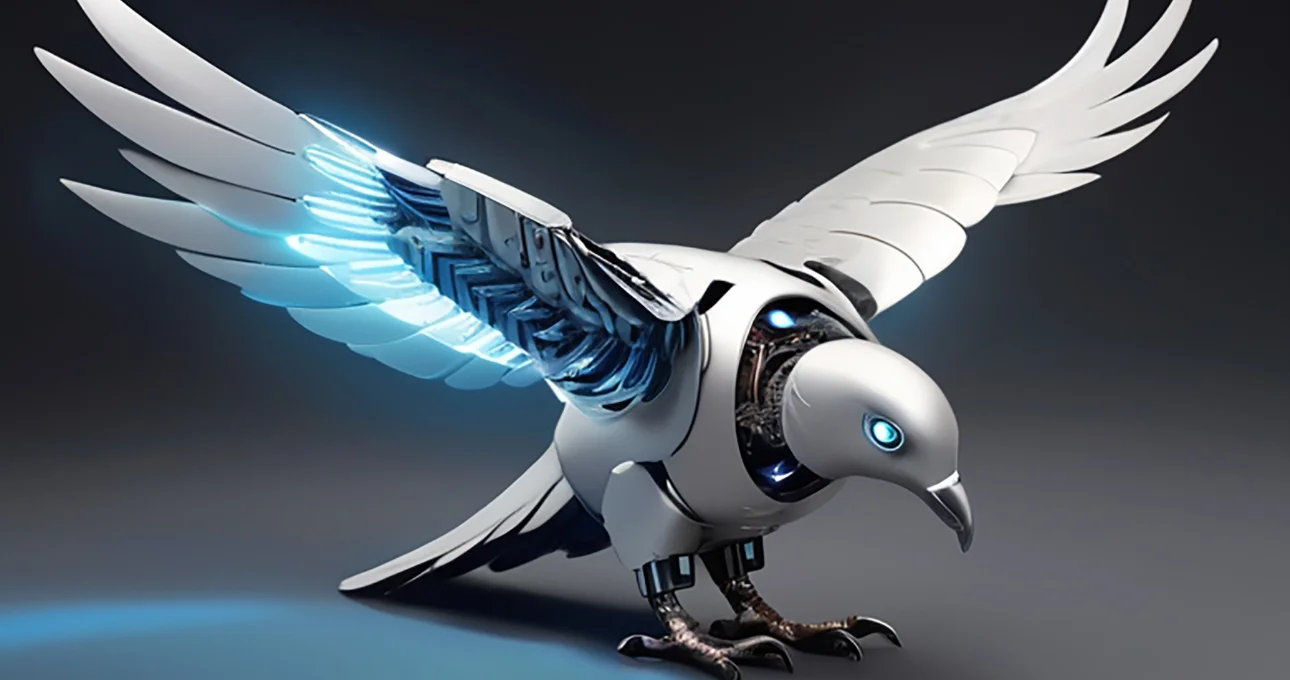
Robotics just crossed an important milestone. What once lived inside research labs and experimental test beds has stepped boldly into the real world. Lumina Tech has officially launched two advanced biomimetic drones — the Bionic Bird and the Flying Fox — both equipped with AI, environmental sensors, imaging systems, and GPS navigation. These next-generation devices replicate the natural elegance of birds and bats, but with a level of intelligence only modern AI can deliver.
This breakthrough, reported by The Times of India, marks a turning point in the evolution of robotics: machines that don’t just copy nature, but learn, adapt, and operate autonomously in unpredictable environments.
Where Nature Meets AI Engineering
Unlike conventional quadcopters, Lumina Tech’s biomimetic drones use flapping-wing mechanics, enabling smoother, quieter, and more energy-efficient flight. Their design is inspired directly by real species:
- Bionic Bird: Swift, agile, and ideal for high-speed scouting
- Flying Fox: Larger wing span, built for stability and endurance
Combined with onboard AI systems, these drones can perform complex environmental tasks with minimal human oversight.
Built for Real-World Use — Not Just Research Labs
Biomimetic drones often struggle to break out of prototype stages due to cost, fragility, or limited real-world application. Lumina Tech appears to have solved that challenge. These new models are engineered for field-ready deployment, expanding into sectors like:
Environmental Monitoring
The drones can map forests, monitor wildlife, assess water quality, and track climate indicators — all while blending into natural habitats.
Infrastructure Inspection
Their nimble flight makes them ideal for inspecting bridges, pipelines, transmission towers, and industrial zones where traditional drones struggle.
Emergency Response
With thermal cameras, hazard detection systems, and AI-assisted navigation, the drones can assist in locating missing persons, identifying fire hotspots, or delivering small emergency supplies.
Urban & Industrial Surveillance
Quiet, efficient flight makes these models suitable for monitoring sensitive urban zones without attracting unwanted attention.
AI Makes the Difference
What sets Lumina Tech’s drones apart is not just the biomimicic design — it’s the onboard AI autonomy layer. Backed by advanced machine-learning models, the drones can:
- Interpret environmental data in real time
- Avoid obstacles intelligently
- Adjust flight paths under changing conditions
- Identify objects or hazards
- Operate independently for long durations
This transforms them from remote-controlled gadgets into true AI-powered agents.
Designed by Innovator Isha Das
At the heart of this development is Isha Das, the lead innovator behind Lumina Tech’s biomimetic robotics division. Her work focuses on bridging natural biomechanics with machine intelligence — an area that is rapidly gaining interest among environmental scientists, defense organizations, and energy companies.
Her vision: robots that operate like wildlife but think like advanced AI systems.
A Major Leap for the Robotics Industry
The launch of the Bionic Bird and Flying Fox signals an important shift. Robotics is no longer constrained to rigid mechanical frames. AI has enabled machines to evolve — literally — into forms that move as naturally as living creatures.
With Lumina Tech pushing biomimetic drones into active operational environments, we may be witnessing the start of a new era in field robotics, where intelligence, agility, and nature-inspired engineering redefine how machines interact with the world.