









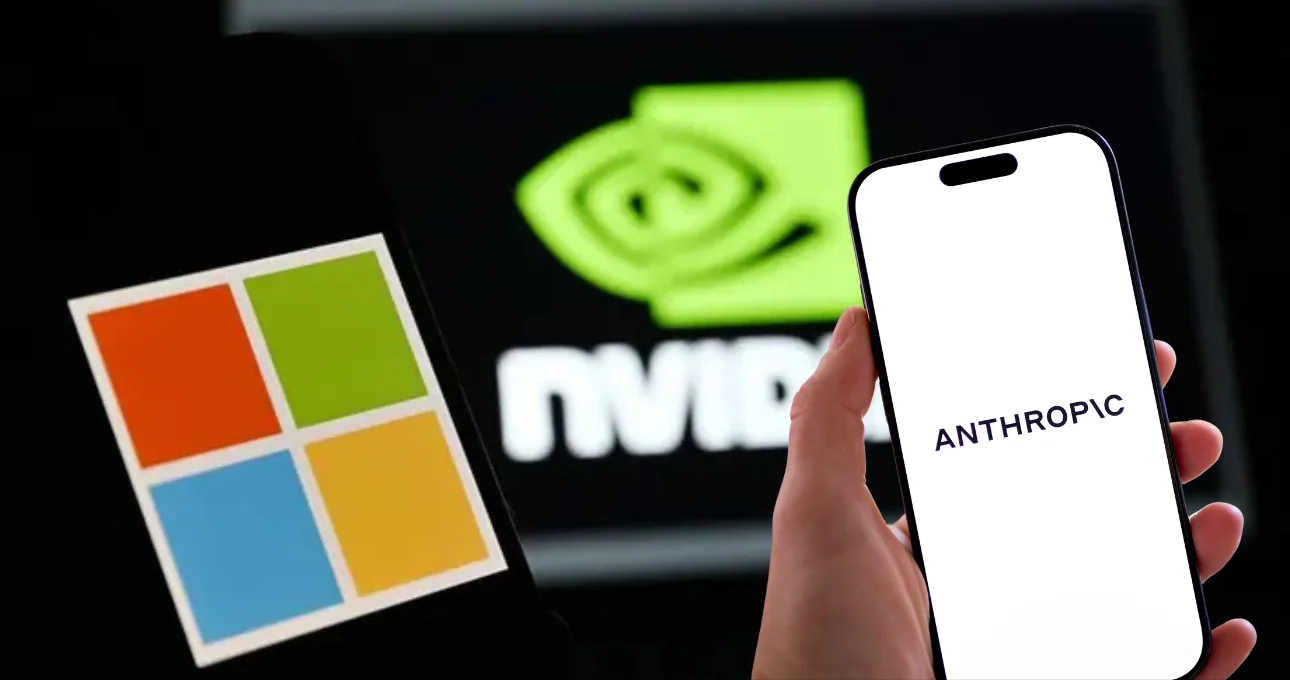
In one of the most defining power moves of the AI decade, Microsoft and Nvidia have together committed up to $15 billion to Anthropic—marking a turning point in how the world’s biggest tech forces are choosing to shape the future of intelligence. This isn’t just another funding round. It’s a strategic triangle that reshapes the equations of cloud power, model development, and semiconductor dominance.
The investment—$10 billion from Nvidia and $5 billion from Microsoft—signals a shared belief: the next breakthroughs in AI won’t come from isolated innovation, but from deeply intertwined ecosystems where chips, cloud, and models evolve together. And Anthropic, with its focus on safe, controllable, and transparent AI, is emerging as a core pillar of this new ecosystem.
Why Anthropic, Why Now?
Anthropic’s Claude family of models has already built a reputation for reliability, guardrails, and enterprise safety. But scaling world-class models requires massive compute muscle. This is where Microsoft and Nvidia step in—not only as investors but as engineering partners.
With this deal, Anthropic will scale Claude on Microsoft Azure, tapping into one of the world’s most powerful cloud AI infrastructures. Meanwhile, compute will run on Nvidia’s newest Grace Blackwell and Vera Rubin AI systems—hardware specifically built for ultra-large model training and inference.
But the partnership doesn’t stop at usage. Nvidia and Anthropic will co-engineer AI hardware, fine-tuning chips to be perfectly optimized for Claude’s unique workload patterns. This is a glimpse into the future of AI development: models and chips evolving hand-in-hand instead of adapting to each other after the fact.
Microsoft’s Strategic Play
For Microsoft, the partnership creates a multi-model ecosystem where Anthropic sits alongside OpenAI. Diversifying its AI engines ensures Azure remains the default cloud for AI development while expanding Copilot with Anthropic’s capabilities.
Anthropic, in return, commits to purchasing approximately $30 billion worth of Azure compute—a staggering number that anchors long-term cloud growth and guarantees infrastructure dominance.
This creates what analysts are calling “circular AI economics”:
Cloud providers and chipmakers invest in model developers → model developers lock in cloud and hardware → innovation accelerates → demand surges → the cycle repeats.
A Bigger Battle Is Brewing
Fundamentally, this $15 billion announcement is more than a partnership—it’s a signal.
The battle for AI leadership is shifting from model-versus-model to ecosystem-versus-ecosystem.
The Nvidia–Microsoft–Anthropic alliance puts pressure on other big players:
- Google with Gemini
- Amazon with its Bedrock ecosystem
- Meta with its open-source strategy
- OpenAI with its unique board-controlled structure
By distributing Claude across multiple clouds and embedding it into consumer and enterprise workflows, Anthropic becomes a heavyweight challenger—one with serious backing and global reach.
What This Means for the Future
The investment underscores one undeniable truth: AI is no longer a product; it’s infrastructure.
Much like electricity or the internet, the next generation of AI will be embedded into every industry, workflow, and device.
With this move, Microsoft and Nvidia are betting on three things:
- Sustainable large-scale AI compute
- Hardware–software co-design as the innovation engine
- Safe, explainable AI as the enterprise standard
And Anthropic is the bridge connecting all three.
Bottom Line
This $15 billion collaboration redefines the rules of engagement in the AI world. It accelerates Anthropic’s capabilities, strengthens Microsoft’s cloud dominance, secures Nvidia’s hardware pipeline, and sets the stage for a future where AI partnerships aren’t transactional—they are symbiotic, engineered, and ecosystem-wide.
The new AI race isn’t about who builds the smartest model.
It’s about who builds the strongest alliances.