









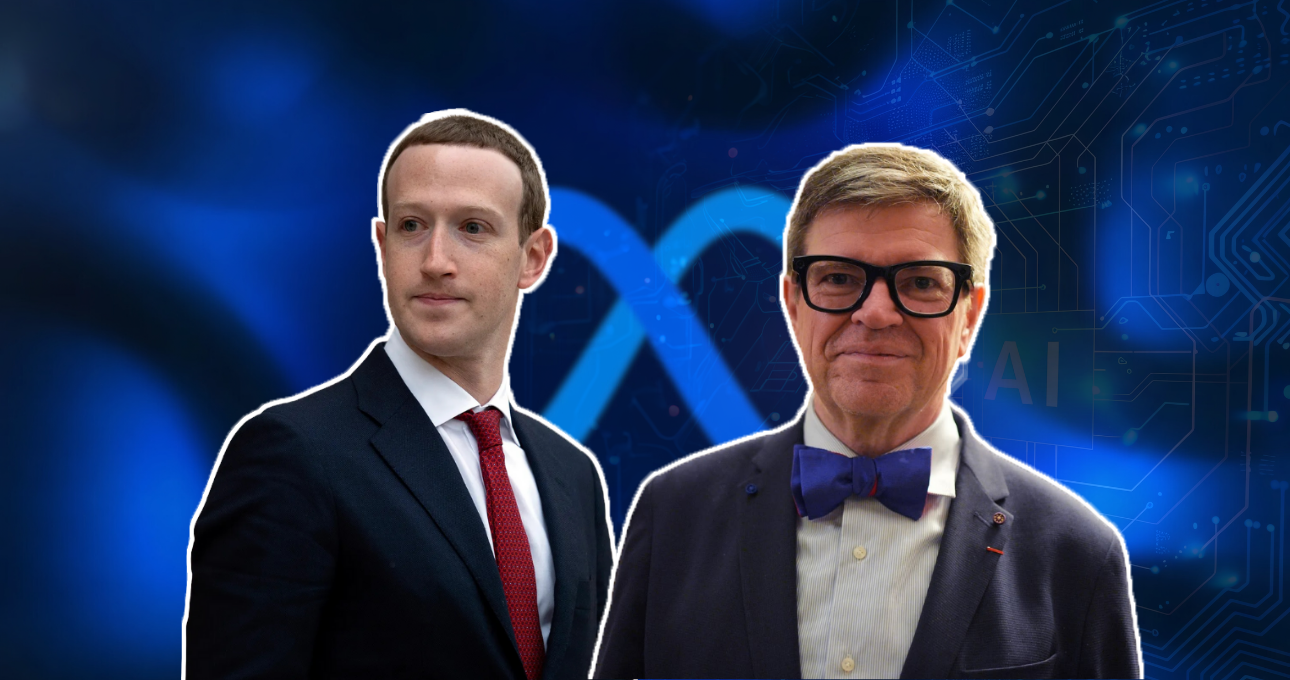
In a move that has electrified the tech world, Yann LeCun, Meta’s long-time Chief AI Scientist and one of the founding fathers of deep learning, is leaving the company to launch his own artificial intelligence startup. The announcement, first reported on November 11, 2025, comes at a time when AI innovation is at a crossroads — powerful, profitable, yet increasingly controversial.
LeCun’s departure marks the end of an era for Meta’s AI research group, which he helped shape into one of the world’s most respected scientific divisions. His next chapter, however, could redefine where AI goes next — especially as he’s been one of the most vocal critics of current “AI hype.”
The Mind Behind Modern AI
Yann LeCun isn’t just another name in tech — he’s the name behind some of the most transformative ideas in machine learning. A Turing Award winner (the Nobel Prize of computing), LeCun pioneered convolutional neural networks (CNNs) — the technology that powers image recognition, autonomous driving, and even your smartphone camera filters.
At Meta (formerly Facebook), LeCun led the company’s Fundamental AI Research (FAIR) lab, a hub known for pushing boundaries beyond commercial AI. Under his leadership, FAIR produced groundbreaking work in computer vision, self-supervised learning, and open-source tools like PyTorch — now a global standard for AI research.
Yet despite his accomplishments, LeCun’s stance on AI has often been contrarian. While companies like OpenAI, Anthropic, and Google DeepMind talk about “Artificial General Intelligence” (AGI) as a near-future reality, LeCun has repeatedly argued that today’s large language models (LLMs) are not intelligent — they’re “glorified parrots.”
What’s Next: A Startup to Rethink Intelligence
Sources close to LeCun suggest his new venture will focus on developing AI systems that learn and reason more like humans — going beyond text prediction to real-world understanding and reasoning. While details remain under wraps, insiders say the startup will prioritize autonomous world models — a concept LeCun has discussed for years — enabling AI to simulate and predict real-world outcomes without human labeling or vast internet data.
This new company is expected to operate independently of Meta, though it may collaborate with academic institutions and open-source communities. Given LeCun’s strong ties to global AI talent, the startup is likely to attract elite researchers who share his vision for a more grounded, scientifically rigorous AI future.
Meta After LeCun: A Shift in Focus
Meta’s AI division, under CEO Mark Zuckerberg, is heavily invested in GenAI for products — including chatbots for WhatsApp and Instagram, and content-generation tools for the metaverse. LeCun’s exit may signal a divergence in philosophy: Meta is betting on commercially viable, product-driven AI, while LeCun is returning to foundational science.
Analysts view this split as symbolic of a larger divide in the AI industry: those focused on profit and platform integration versus those pushing for new architectures and cognitive breakthroughs.
Why This Matters
LeCun’s move is more than a resignation — it’s a statement. It suggests that the next big wave in AI won’t come from corporate labs chasing user engagement, but from smaller, focused research-driven startups seeking to build real intelligence, not just mimic it.
As he embarks on this new journey, the AI world watches closely. If his past work is any indicator, Yann LeCun’s next chapter could once again rewrite the rules of what machines can truly learn — and how close they can come to thinking like us.