






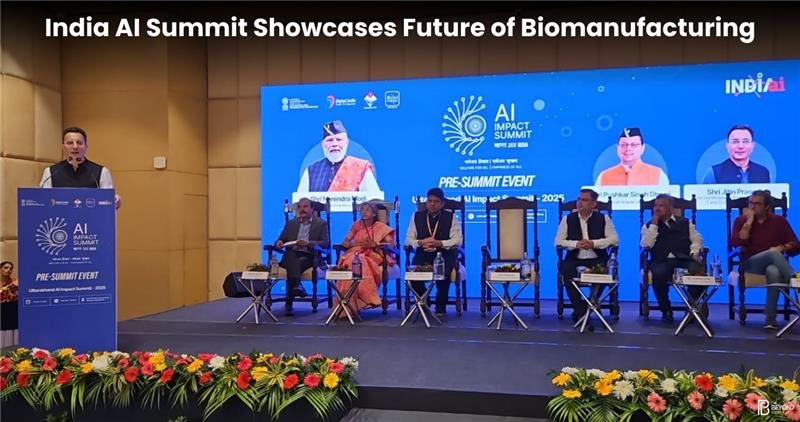
India is taking a bold step toward the future of manufacturing — not with machines alone, but with living cells powered by artificial intelligence. At the India AI Impact Summit, experts, researchers, and industry leaders highlighted how the convergence of AI and biology — known as BioAI — could transform biomanufacturing and unlock a new era of sustainable production.
The discussions revealed a powerful vision: using artificial intelligence, genomics, and in-silico design to create smarter, faster, and more reliable biological manufacturing systems.
What Is BioAI and Why It Matters
BioAI refers to the integration of artificial intelligence with biological sciences to design, optimize, and scale biological processes. Instead of relying solely on traditional laboratory experimentation, scientists can now use AI models to simulate and predict biological behavior digitally.
This approach significantly reduces the time, cost, and risk involved in developing biological products.
Biomanufacturing uses living cells — such as microbes — to produce valuable products, including vaccines, medicines, biofuels, and sustainable materials. With AI, this process becomes faster, more precise, and scalable.
At the summit, experts emphasized that AI can analyze massive genomic datasets, identify patterns, and recommend optimized biological designs that would take years to discover through conventional methods.
In-Silico Design: Revolutionizing Biological Development
One of the key highlights of the summit was the growing role of in-silico design — the use of computer simulations to design biological systems.
Using AI, scientists can now design and test biological models virtually before conducting real-world experiments. This dramatically accelerates innovation.
Instead of running thousands of physical lab tests, researchers can narrow down the most promising options using AI simulations.
This not only speeds up development but also improves accuracy and efficiency.
In-silico design is already being used globally in drug discovery, enzyme engineering, and synthetic biology.
The Power of Genomics and Data Loops
Genomics — the study of genetic material — plays a central role in BioAI.
Artificial intelligence can process enormous genomic datasets and uncover insights that humans alone cannot detect.
At the summit, speakers highlighted the importance of continuous data loops, where AI systems learn from real-world biological experiments and improve over time.
This creates a feedback cycle where each experiment makes the system smarter.
Such data-driven approaches build trust, reliability, and scalability — critical factors for industrial biomanufacturing.
Transforming India’s Manufacturing and Healthcare
BioAI has the potential to transform multiple industries in India.
In healthcare, it could accelerate vaccine development, reduce costs, and improve accessibility.
In manufacturing, it could enable sustainable production of chemicals, materials, and fuels using biological systems instead of traditional industrial methods.
This could reduce environmental impact and support India’s sustainability goals.
Experts believe India is well positioned to become a global leader in AI-driven biomanufacturing due to its strong biotechnology sector and growing AI ecosystem.
Building Trust and Scale Through AI
One of the biggest challenges in biomanufacturing is ensuring consistency and reliability.
AI can help monitor biological processes in real time, detect anomalies, and optimize performance.
This improves quality control and builds confidence among manufacturers and regulators.
By combining artificial intelligence with biology, companies can move from trial-and-error approaches to predictive, data-driven manufacturing.
The Future: AI-Driven Biological Economy
The discussions at the summit made one thing clear: the future of manufacturing may be biological — and AI will power it.
BioAI represents a shift from traditional industrial production to intelligent, sustainable, and scalable biological systems.
As artificial intelligence continues to evolve, its integration with biology could reshape industries, economies, and healthcare.
India’s focus on this convergence signals its ambition to play a leading role in the global bioeconomy.
The message from the summit was clear — when AI meets biology, the possibilities are limitless.