









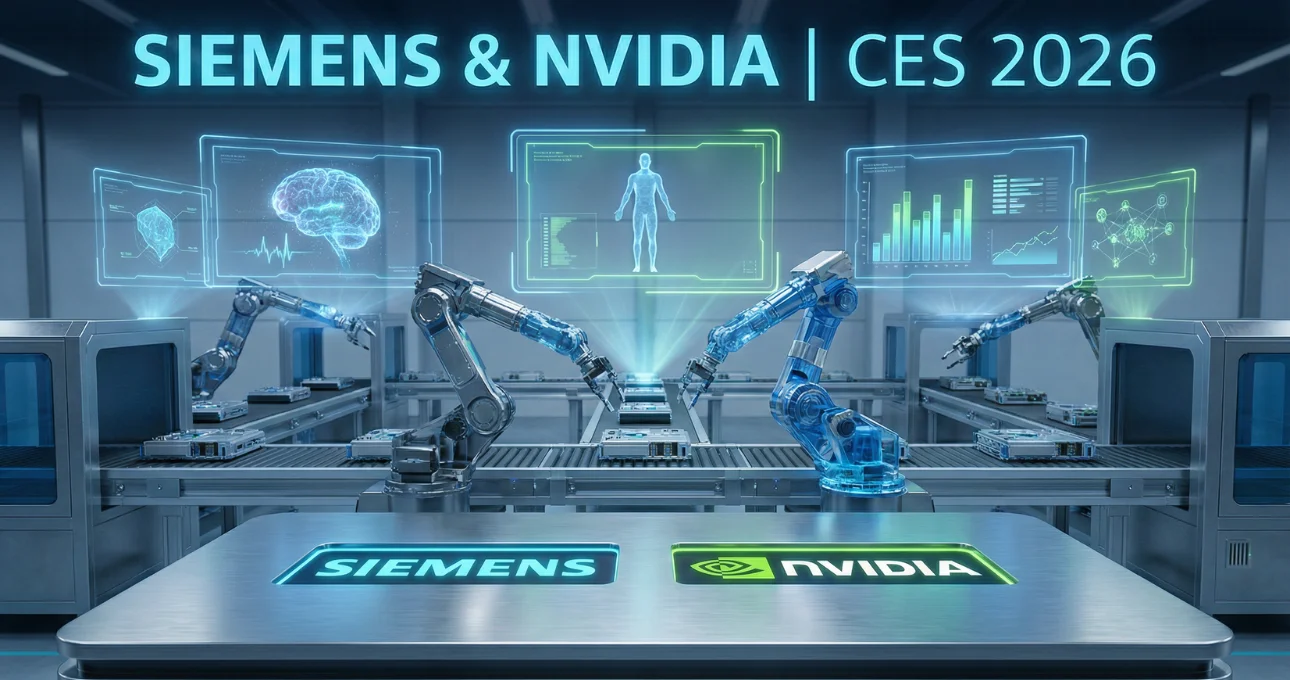
Industrial technology is entering a new phase—one where artificial intelligence is no longer confined to analytics dashboards or pilot projects but embedded directly into how factories are designed, simulated, and operated. In a major step toward that future, Siemens and NVIDIA have expanded their long-standing partnership to develop an Industrial AI operating system that tightly connects design, manufacturing, automation, and digital twins into a single, intelligent framework.
This collaboration signals a shift from fragmented industrial software tools to a unified, AI-native industrial stack—one capable of handling the complexity of modern manufacturing at scale.
From Digital Twins to Living Industrial Systems
At the heart of the partnership is the integration of Siemens’ industrial software portfolio—including its Xcelerator platform—with NVIDIA’s AI, simulation, and accelerated computing technologies. The goal is to create a shared digital foundation where products, factories, and operations exist as continuously updated digital twins, not static models.
Instead of designing a product in one system, simulating it in another, and manufacturing it in yet another, the Industrial AI OS enables a closed feedback loop. Data from real-world factory floors flows back into simulations, while AI models continuously optimize design, production efficiency, energy usage, and predictive maintenance.
This approach transforms digital twins into living systems that evolve in real time.
AI at Every Layer of Industrial Operations
What makes this initiative different from traditional industrial automation is the depth of AI integration. NVIDIA’s AI and simulation stack—powered by accelerated GPUs and advanced frameworks—brings real-time physics simulation, generative AI, and autonomous decision-making into Siemens’ industrial environments.
Manufacturers can simulate entire production lines before physical deployment, test automation strategies virtually, and use AI to identify bottlenecks or failure points long before they appear in the real world. Over time, factories become self-optimizing systems, learning from data and adapting to demand changes, supply chain disruptions, and sustainability targets.
Bridging IT and OT Like Never Before
One of the biggest challenges in industrial transformation has been the disconnect between IT systems (software, data, analytics) and operational technology (OT) on the factory floor. The Siemens–NVIDIA Industrial AI OS aims to bridge this gap by creating a common platform that spans engineering, operations, and automation.
By unifying these domains, organizations can move faster—from design to deployment—while reducing errors, rework, and downtime. This is especially critical for industries such as automotive, aerospace, energy, electronics, and heavy manufacturing, where complexity and precision are non-negotiable.
Why This Matters for the Future of Manufacturing
As global manufacturers face pressure to localize production, reduce emissions, and respond faster to market shifts, traditional automation models are no longer enough. AI-driven industrial platforms offer a way to scale innovation without scaling inefficiency.
The Siemens–NVIDIA partnership positions industrial AI not as an add-on, but as the operating system of the factory itself—one that supports sustainability goals, workforce augmentation, and resilient supply chains.
A Blueprint for Industry 5.0
This expanded collaboration goes beyond incremental improvement. It represents a blueprint for Industry 5.0, where humans, machines, and AI systems collaborate seamlessly. Engineers gain better tools, operators gain smarter automation, and enterprises gain real-time visibility across their entire industrial ecosystem.
As AI reshapes software, cloud, and data centers, this partnership shows that manufacturing is next—and it’s happening at the operating system level.
In the race to build smarter, more adaptive factories, Siemens and NVIDIA are not just improving industrial processes—they’re redefining how industry itself runs.