










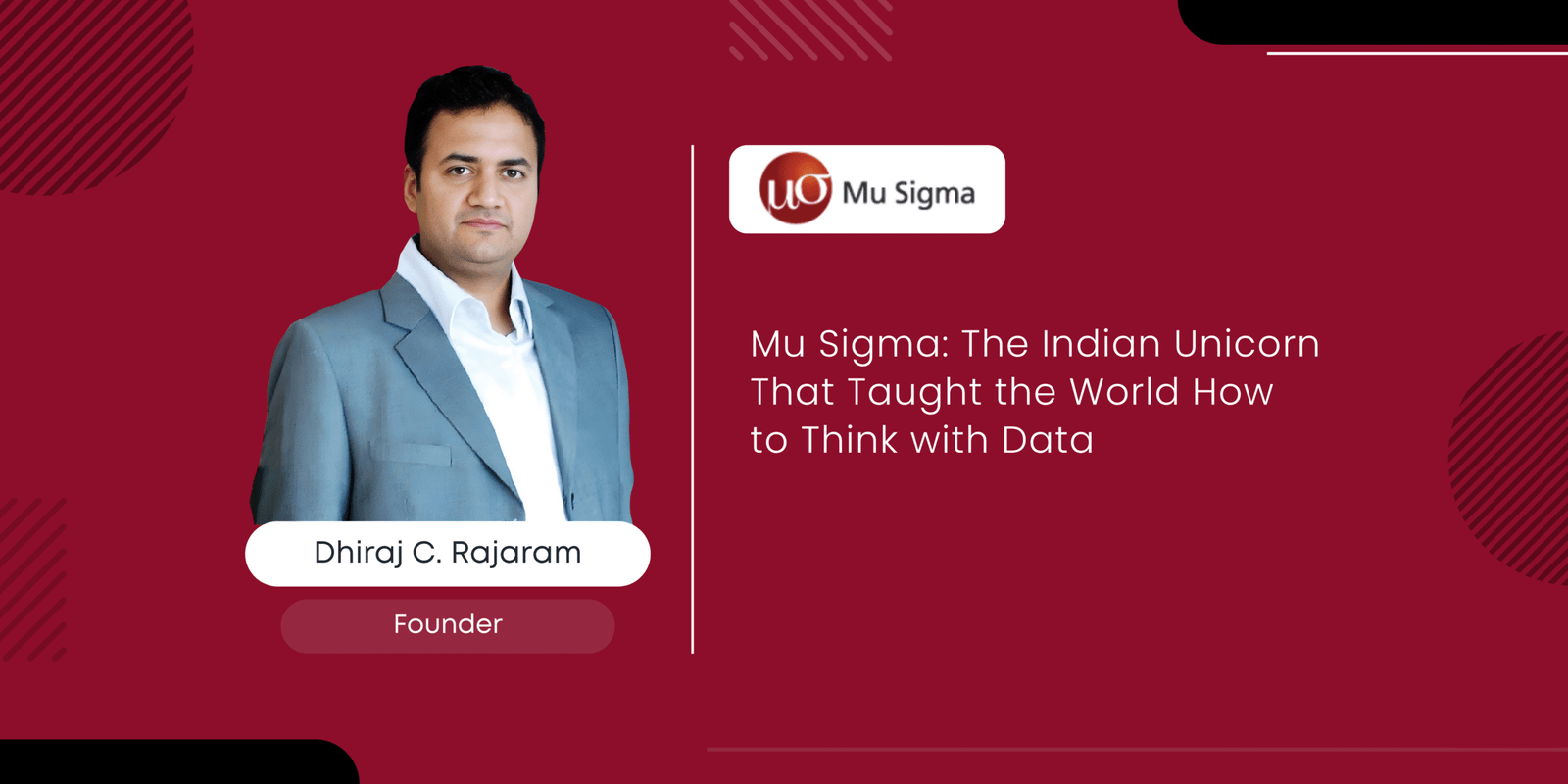
Back in 2004, before “data science” became the buzzword it is today, Dhiraj C. Rajaram saw something the world hadn’t yet noticed — businesses were drowning in data but starving for decisions.
Armed with his experience from Booz Allen Hamilton and PwC, Rajaram envisioned a company that could turn data into a decision engine for enterprises. That idea gave birth to Mu Sigma, a startup that didn’t just offer analytics — it built an entirely new discipline: Decision Sciences.
The Birth of a New Discipline
Rajaram wasn’t satisfied with companies treating analytics as a backend function. He believed that mathematics, technology, and business should come together to create continuous decision-making systems — not just one-off insights.
He coined the term “Decision Sciences” — and with that, a new industry was born.
Unlike other consulting firms, Mu Sigma didn’t just analyze data. It engineered decision-making itself — building frameworks that helped Fortune 500 companies institutionalize curiosity, experimentation, and learning as everyday business tools.
Rajaram’s mantra was simple yet radical:
“The future of business belongs to organizations that can learn faster than the rate of change.”
From a Single Apartment to a Billion-Dollar Revolution
The early days were far from easy. Rajaram famously sold and mortgaged his home to fund Mu Sigma — betting everything on his belief that data-driven decision-making would transform the world.
At a time when businesses were skeptical about analytics, he had to first educate his clients on why it mattered. That conviction paid off when Microsoft became Mu Sigma’s first client in 2005 — a turning point that opened doors to Walmart, Pfizer, Dell, and hundreds more.
From a small team in Bengaluru, Mu Sigma grew into a global powerhouse valued at over $1.5 billion, making it one of India’s first analytics unicorns. Its unique model — blending human insight with AI and automation — became a gold standard for enterprise problem-solving.
The Philosophy That Changed How Businesses Think
Rajaram’s philosophy wasn’t about chasing perfection — it was about cultivating “extreme experimentation.”
Mu Sigma encouraged clients to run small, fast experiments, learn from failure, and continuously adapt.
This mindset turned data from a static asset into a living system — one that could evolve alongside markets, technologies, and human behavior.
His vision of a “man–machine ecosystem”, where AI enhances human judgment rather than replacing it, positioned Mu Sigma years ahead of the generative AI wave that followed.
Global Impact and the Road Ahead
Today, Mu Sigma partners with over 140 Fortune 500 companies, helping them make better, faster, and smarter decisions in a complex world.
Rajaram’s influence extends beyond his company — he’s been featured in Fortune’s “40 Under 40”, named EY Entrepreneur of the Year, and celebrated as one of the pioneers who helped put India on the global deep tech map.
But perhaps his greatest legacy is cultural: he proved that India could not just provide analytics talent — it could define the analytics industry itself.
The Enduring Lesson
Mu Sigma’s story is not just about numbers or valuations — it’s about thinking differently.
It’s a story of one man’s belief that curiosity is the new currency, and that in the age of AI and uncertainty, the companies that will thrive are the ones that keep asking better questions.
From one man’s conviction to a billion-dollar movement, Mu Sigma didn’t just build a company — it built a mindset.