










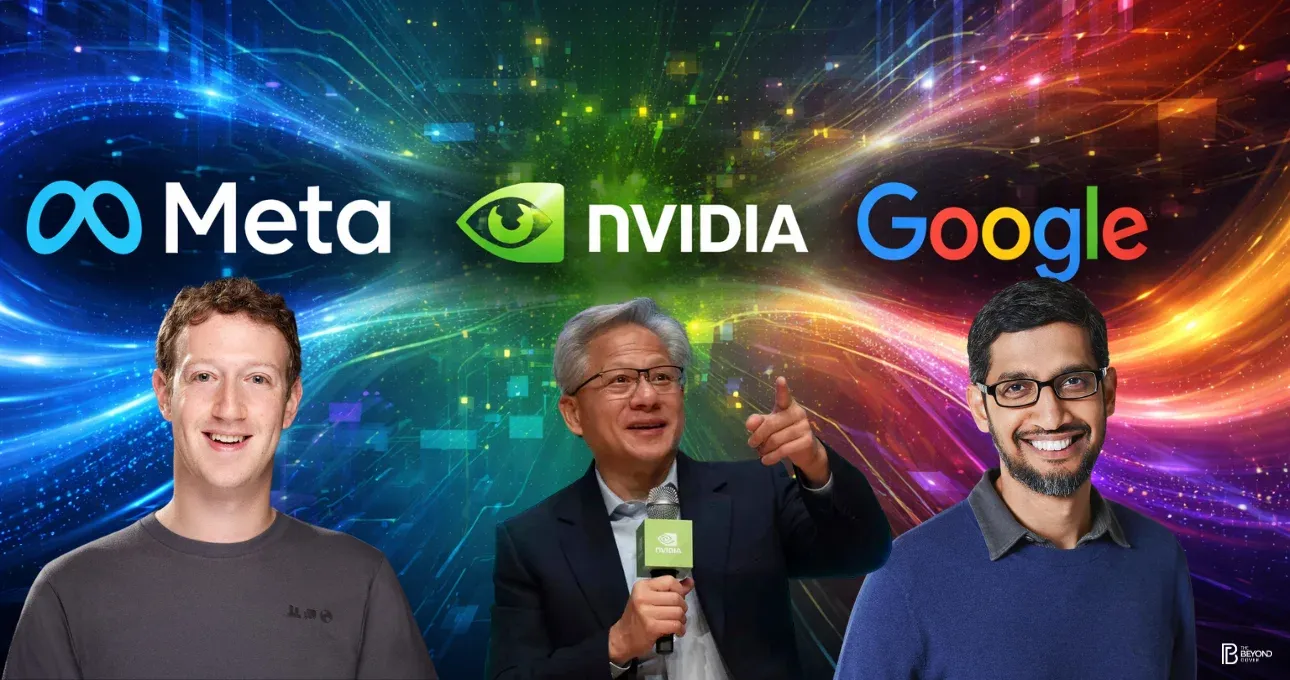
In a significant shift for the AI infrastructure landscape, Meta has signed a multi-year agreement to use Google’s Tensor Processing Units (TPUs) for training and running its AI models. Confirmed on February 26, 2026, the move marks the first time Meta is scaling its artificial intelligence workloads on hardware outside its long-standing Nvidia ecosystem.
For everyday users, this backend transition simply means faster, smarter AI features across Meta platforms—from more accurate recommendations to smoother generative tools—without the delays caused by global chip shortages.
From Heavy Nvidia Dependence to a Multi-Vendor Strategy
Meta has been one of Nvidia’s largest customers, investing heavily in GPUs such as the H100 to train its Llama models. However, surging global demand for AI compute has made relying on a single supplier increasingly risky.
By bringing Google Cloud TPUs into its infrastructure, Meta is:
- Securing long-term compute capacity
- Reducing supply chain pressure
- Improving energy efficiency for large-scale AI training
TPUs are purpose-built for the kind of mathematical operations used in large language models, and in certain workloads they can deliver significantly better performance per watt—an important factor as data centre power consumption continues to rise.
This is not a replacement for Nvidia, but a diversification strategy designed to keep Meta’s AI roadmap on schedule.
Faster AI Rollouts Across Meta Apps
The biggest impact will be visible in product speed and capability.
With additional compute power, Meta can:
- Train larger and more advanced Llama models faster
- Roll out new AI features more frequently
- Improve personalisation across its platforms
That translates into quicker deployment of tools such as:
- AI-driven content recommendations
- Generative creative features
- AR and virtual experiences
- Intelligent messaging enhancements
For developers building on the Llama ecosystem, the deal also opens up Google Cloud TPUs as an alternative infrastructure option—potentially lowering costs and reducing dependence on limited GPU availability.
A Turning Point in the AI Chip Wars
Meta’s decision reflects a broader industry trend: hyperscalers are moving toward multi-vendor compute strategies.
Key shifts underway include:
- Google offering its once-internal TPUs as a cloud product
- New competition from AMD and Intel in AI accelerators
- Growing demand that is doubling global AI compute needs year after year
In this environment, guaranteed access to compute is becoming more important than relying on a single, fastest chip.
By locking in long-term capacity with multiple partners, Meta gains flexibility, pricing leverage and resilience against geopolitical or supply disruptions.
Why This Matters for the Global and Indian Tech Ecosystem
The ripple effects go far beyond Meta.
A diversified AI hardware model:
- Reduces dependence on one dominant supplier
- Encourages competitive pricing in cloud AI infrastructure
- Makes advanced AI training more accessible to startups and enterprises
For emerging AI markets, including India, this signals a future where companies can scale AI using a mix of cloud platforms rather than being constrained by GPU shortages.
It also accelerates the growth of tools and platforms that support hybrid and multi-cloud AI deployments.
The Road Ahead: Faster Models, Smarter Platforms
Meta’s TPU adoption highlights a new phase in the AI race—where success depends not just on model innovation, but on infrastructure strategy.
As more compute becomes available, users can expect:
- Faster feature rollouts
- More powerful AI assistants
- Richer immersive experiences
Behind the scenes, the competition between cloud providers, chipmakers and hyperscalers will continue to intensify. On the surface, it will simply feel like Meta’s apps are getting smarter and more responsive.