









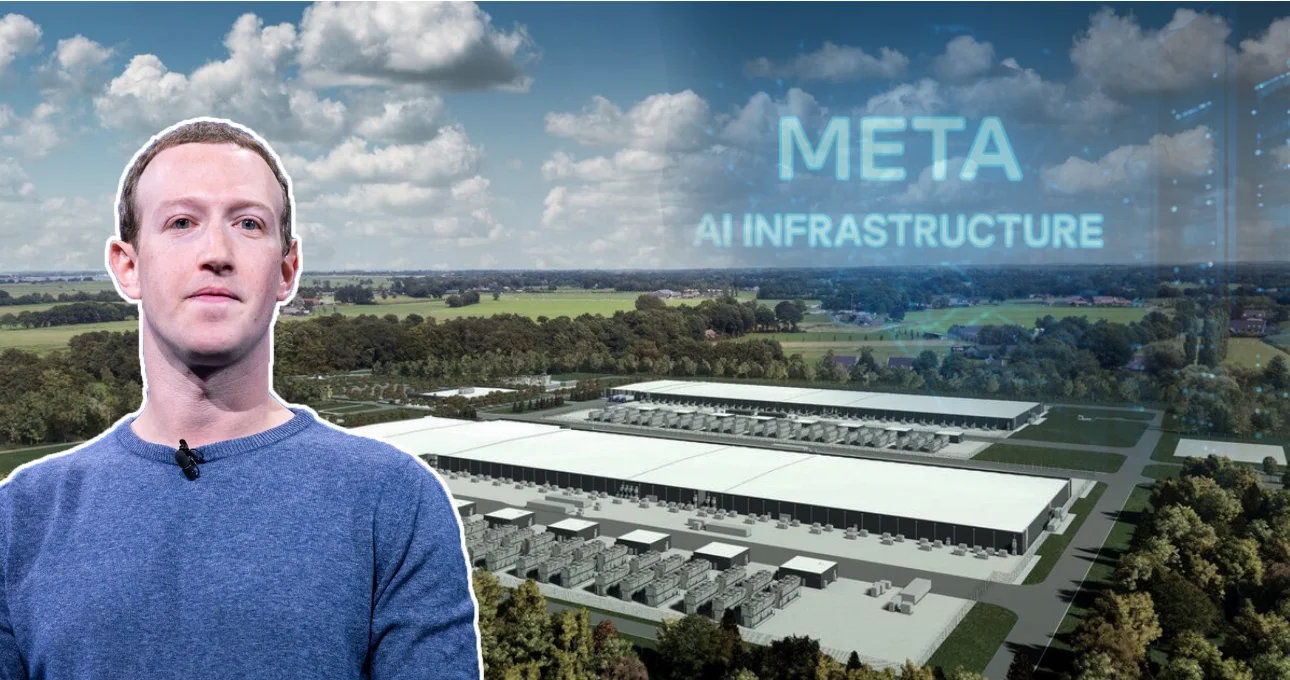
Meta Platforms, the parent company of Facebook, Instagram, and WhatsApp, has officially broken ground on a massive $1 billion AI-focused data center in Beaver Dam, Wisconsin — marking a major milestone in its global infrastructure expansion. The project underscores Meta’s growing bet on artificial intelligence, as the company continues to build the digital backbone needed to power its next wave of products and experiences.
A Data Center Built for the AI Era
Unlike traditional data centers designed primarily for storage and connectivity, Meta’s new facility will be purpose-built for AI workloads — from training large-scale models to running next-gen recommendation systems and generative AI tools. The facility will host cutting-edge servers optimized for high-speed data processing, supporting everything from AI-driven video curation on Instagram to immersive environments in the metaverse.
Meta says this is part of its broader effort to “reimagine data infrastructure for an AI-first world.” Once completed, the Wisconsin data center will join Meta’s global network of 30+ hyperscale facilities and serve as one of the company’s key hubs for AI compute capacity in North America.
Sustainability at the Core
One of the most notable aspects of the new project is its focus on sustainability and energy efficiency. The Beaver Dam data center will utilize advanced dry-cooling technology, a system that dramatically reduces water usage compared to traditional liquid cooling methods. This aligns with Meta’s ongoing goal to achieve net-zero emissions across its operations by 2030.
The company has also pledged to source 100% of the electricity for the Wisconsin site from renewable energy projects, including local solar and wind farms. According to Meta, the facility will not only advance AI innovation but also serve as a model for green, scalable digital infrastructure.
Economic and Community Impact
Meta’s billion-dollar investment is expected to inject a significant boost into the Wisconsin economy, generating hundreds of construction jobs and dozens of high-skill positions in data engineering, systems operations, and AI research. Local officials have hailed the project as a “transformational development,” pointing to the ripple effects it will create across regional suppliers, tech education programs, and small businesses.
The Beaver Dam site was chosen for its strategic location, offering strong power infrastructure, access to renewable energy, and proximity to talent pools from nearby universities like the University of Wisconsin–Madison. It also cements Wisconsin’s growing reputation as a technology hub in the American Midwest.
Meta’s Broader AI Vision
This announcement comes at a time when Meta is doubling down on its AI strategy. From developing its Llama open-source models to deploying AI-powered assistants across its social platforms, Meta is positioning itself as a serious competitor in the global AI race — not just as a social media company, but as an AI infrastructure powerhouse.
The Beaver Dam facility is expected to become operational in late 2026, and once fully scaled, it will provide Meta with unprecedented computational capacity to support its global ecosystem of apps, AI models, and metaverse technologies.
In conclusion, Meta’s new Wisconsin data center is more than a physical expansion — it’s a symbol of how the AI revolution is reshaping the world’s digital foundations. For Meta, it’s both a strategic and philosophical statement: the future of intelligence will be built not just in Silicon Valley, but in every corner where data, energy, and innovation intersect.