










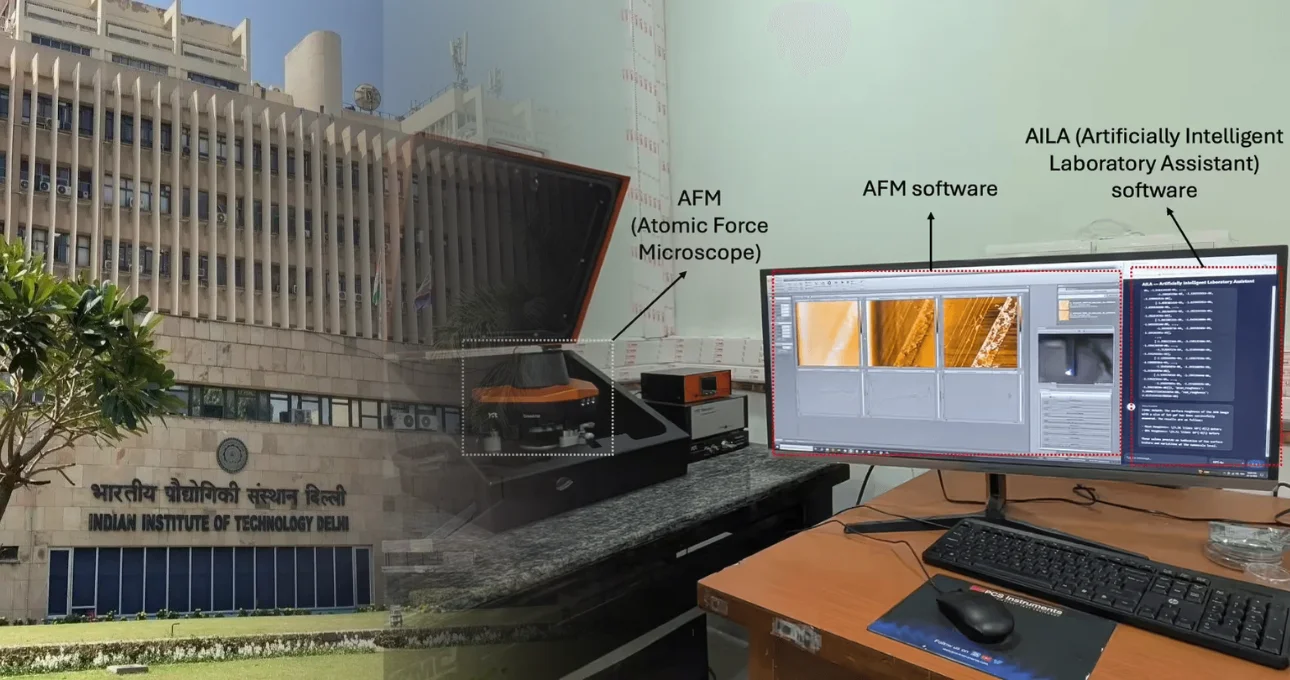
India has taken a significant step toward the future of scientific research with the launch of AILA (AI Lab Assistant) by IIT Delhi. Designed as an advanced agentic AI system, AILA can autonomously design, execute, and analyze laboratory experiments—marking a breakthrough in how artificial intelligence is being embedded into real-world scientific workflows.
The development highlights India’s growing role in cutting-edge AI innovation and demonstrates how agentic AI is moving beyond business automation into core research and discovery processes.
What Is AILA and Why It Matters
AILA is not just another data analysis tool. Unlike conventional AI systems that rely heavily on human instructions at every step, AILA operates as an autonomous research agent. It can plan experiments, determine required materials and parameters, run lab procedures, collect results, and refine future experiments based on outcomes.
This capability positions AILA as a virtual research assistant that can significantly reduce the time scientists spend on repetitive or trial-and-error tasks. By automating routine experimentation, researchers can focus more on hypothesis building, interpretation, and innovation.
For a country like India, where research institutions often face resource and manpower constraints, such technology could be transformative.
Agentic AI Enters the Laboratory
AILA exemplifies the rise of agentic AI, a class of systems designed to make decisions, take actions, and learn iteratively with minimal human intervention. In a laboratory setting, this means AI can move from being a passive tool to an active participant in scientific discovery.
The system can analyze prior research data, design optimal experimental setups, and adjust variables in real time based on observed results. This adaptive learning capability allows AILA to optimize experiments faster than traditional manual approaches.
Such systems could be particularly valuable in fields like materials science, chemistry, biotechnology, and physics, where experimentation cycles are time-consuming and costly.
Accelerating Research and Innovation
One of AILA’s biggest advantages is speed. Traditional lab experiments often involve long cycles of planning, execution, analysis, and repetition. AILA compresses these cycles by continuously learning from each experiment and refining the next one automatically.
This acceleration has far-reaching implications. Faster experimentation can shorten research timelines, reduce costs, and enable quicker translation of academic research into real-world applications. For industries reliant on R&D—such as pharmaceuticals, semiconductors, and clean energy—AI-driven labs could become a major competitive advantage.
Strengthening India’s Research Ecosystem
The development of AILA also reflects India’s push to build homegrown AI capabilities rather than relying solely on global platforms. By creating advanced research tools domestically, institutions like IIT Delhi are strengthening India’s technological sovereignty and innovation ecosystem.
AILA could also play a role in democratizing research. Smaller labs and universities, which may lack large research teams, could use AI assistants to enhance productivity and compete at a global level.
Ethical Oversight and Human Control
Despite its autonomy, AILA is designed to operate under human supervision. Researchers remain responsible for defining goals, validating results, and ensuring experiments meet ethical and safety standards. This human-in-the-loop approach is essential, especially in scientific domains where errors or misuse could have serious consequences.
The system’s development also raises important discussions around accountability, reproducibility, and transparency in AI-driven research—topics that will become increasingly relevant as agentic AI adoption grows.
A Glimpse Into the Future of Science
AILA represents more than a single innovation—it signals a shift in how scientific research may be conducted in the coming decade. As AI agents become more capable, laboratories of the future could operate as human–AI collaborative environments, where machines handle execution and optimization while humans guide strategy and creativity.
With AILA, IIT Delhi has placed India at the forefront of this transformation. The project demonstrates that agentic AI is no longer theoretical—it is actively reshaping how science is done, opening new possibilities for faster discoveries and smarter research workflows.