









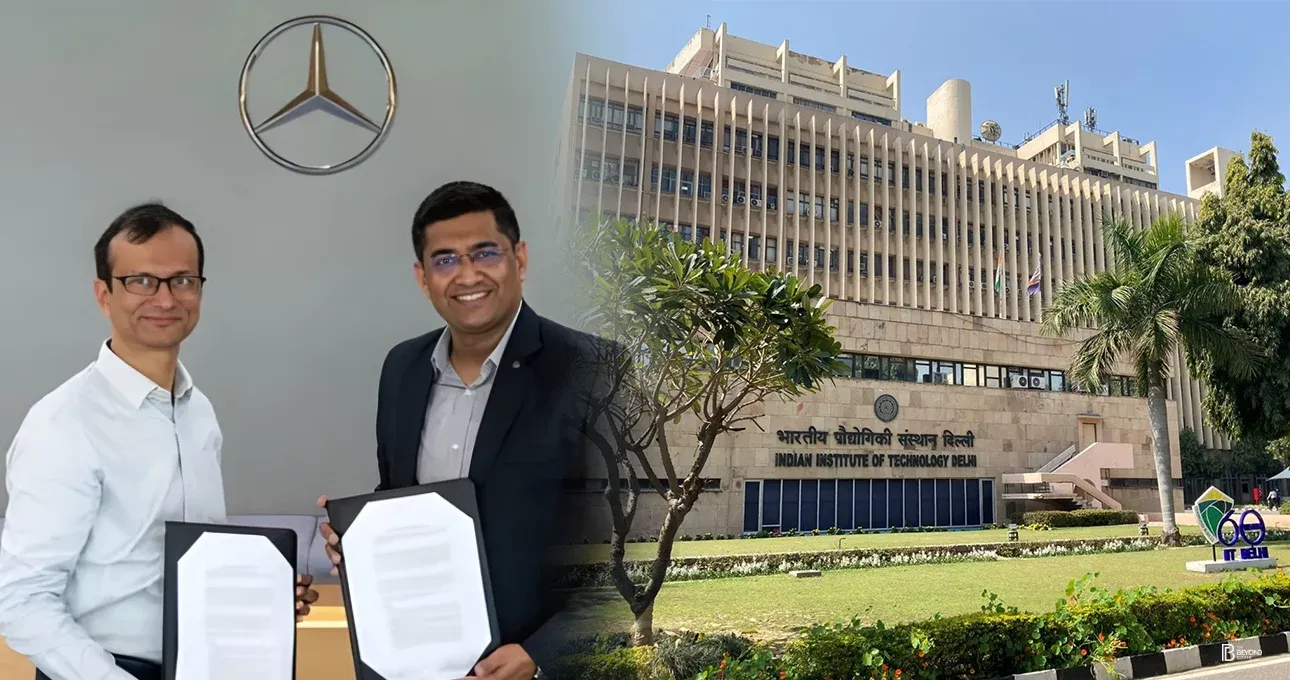
India’s electric mobility journey is gaining serious momentum. A new collaboration between Indian Institute of Technology Delhi and Mercedes-Benz Research and Development India aims to reshape the future of electric vehicles through advanced research and technology.
Announced on March 5, 2026, the two organizations signed a five-year Master Research Agreement (MRA) focused on exploring next-generation technologies such as quantum sensing, advanced battery systems, neuromorphic engineering, and future materials. The goal is simple: build smarter, more efficient electric vehicles and strengthen India’s role in global EV innovation.
For anyone interested in Mercedes EV technology, this partnership could influence the next wave of Mercedes Benz EV models and Mercedes sedan platforms developed in the country.
A Collaboration Driving EV Innovation
The partnership connects the research expertise of IIT Delhi with the engineering capabilities of Mercedes-Benz Research and Development India (MBRDI). The Bengaluru-based R&D center, which recently marked 30 years of operations in India, will work closely with IIT researchers to develop technologies that can eventually move from laboratory experiments to real-world vehicles.
The first major research focus is quantum sensors and advanced battery systems. These projects are being led by Professor Nirat Ray from IIT Delhi’s Department of Materials Science and Professor Saurabh Saxena from the Centre for Automotive Research and Tribology (CART).
Quantum sensors could detect microscopic changes inside EV batteries, helping engineers monitor wear and performance at an atomic level. This type of technology could extend battery life and improve reliability for future Mercedes Benz EV vehicles.
Another area of research involves neuromorphic engineering, which focuses on developing computing systems inspired by the human brain. Such chips may one day support smarter autonomous driving systems that can better interpret complex traffic conditions.
What This Means for Future Mercedes EVs
If these research projects succeed, the impact on electric mobility could be significant.
Advanced battery research may lead to longer-lasting EV batteries, potentially increasing vehicle lifespan and improving range. Quantum sensing technology could help manufacturers detect battery degradation early, ensuring better safety and performance.
Future materials research is also expected to reduce vehicle weight while maintaining structural strength. Lighter vehicles typically deliver better efficiency, improved acceleration, and longer range—an important factor for upcoming Mercedes sedan EV models.
Neuromorphic chips may also support advanced driver-assistance systems, enabling vehicles to process road information faster and more efficiently.
Together, these innovations could influence future Mercedes EV platforms designed both for India and global markets.
Boost for India’s EV Ecosystem
The collaboration also highlights India’s growing role in global automotive innovation. With over 6,000 engineers working at Mercedes-Benz R&D India, the country already plays a major role in developing next-generation automotive technology.
Working with IIT Delhi strengthens the pipeline of research talent and creates opportunities for students, engineers, and startups focused on electric mobility.
Industry experts believe collaborations like this can accelerate India’s EV ecosystem, supporting everything from battery research to smart mobility systems.
A Step Toward the Future of Electric Mobility
As governments and companies worldwide push toward cleaner transportation, partnerships between academia and industry are becoming increasingly important.
The IIT Delhi–Mercedes collaboration is a clear example of how research and engineering can work together to build the next generation of electric vehicles.
From advanced batteries to intelligent driving systems, the innovations developed through this partnership could shape the future of Mercedes Benz EV technology—and strengthen India Benz engineering capabilities on the global stage.