










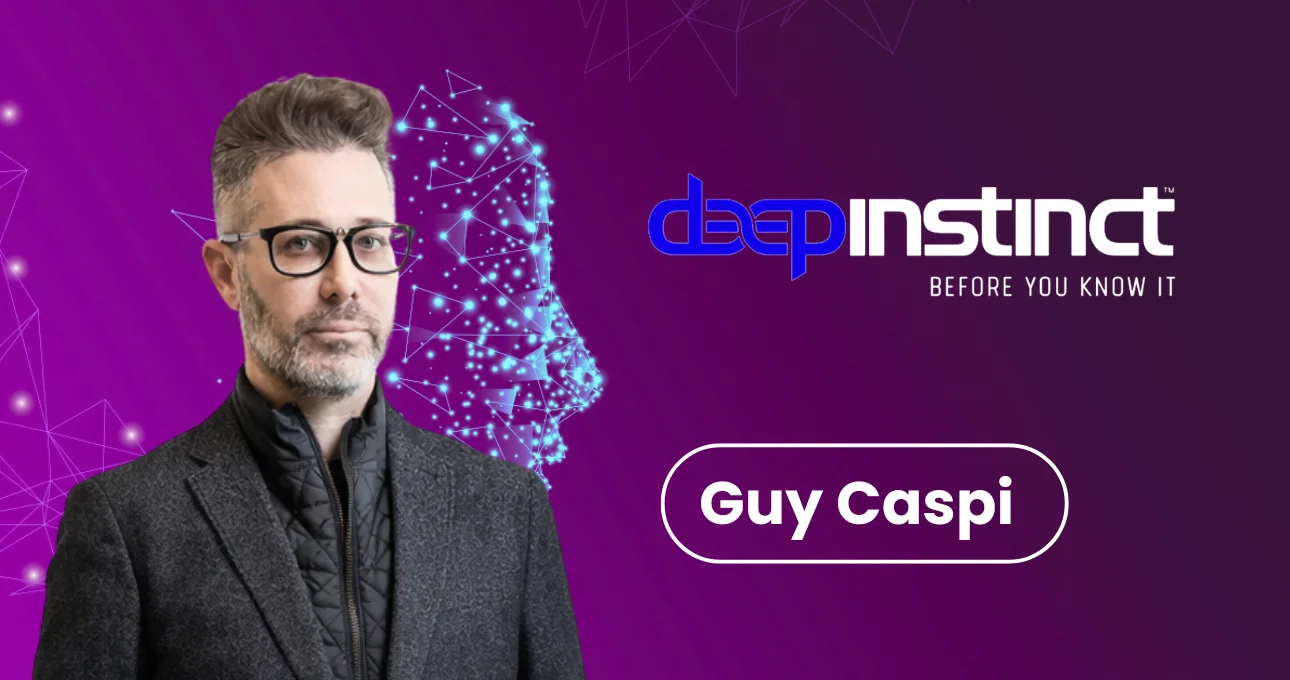
In a time where cyber dangers are advancing more quickly than ever, driven by automation and artificial intelligence. Deep Instinct has appeared as a forerunner in security, prioritizing prevention. Unlike older cybersecurity providers that focus on finding and reacting to threats, Deep Instinct utilizes deep learning to foresee and halt dangers before they run, establishing a fresh standard for safeguarding endpoints and data.
Established in 2015 in Tel Aviv, Israel, the firm has built its standing on a bold assertion: stopping malware in under 20 milliseconds with effectiveness exceeding 99% and very few mistaken alerts. Its main offering, DSX (Deep Security eXtended), shows a core change in how cybersecurity systems are built—shifting from a reactive stance to proactive blocking.
This piece delves into Deep Instinct’s beginnings, key achievements, leadership progression, and the technological advantage that positions it as a frontrunner in deep learning for cybersecurity.
Founders’ Vision: Bringing Deep Learning to Cyber Defense
Three Israeli visionaries started Deep Instinct:
- Guy Caspi
- Dr. Eli David
- Nadav Maman
Each contributed a distinct viewpoint to the company’s goal of transforming cybersecurity using deep neural networks.
Guy Caspi, an experienced entrepreneur with over twenty years in enterprise software, pictured a system that could neutralize threats before they were activated. His concept involved using GPU-driven deep learning structures, trained on huge volumes of harmless and harmful files, to anticipate threats with unmatched precision.
Dr. Eli David, an AI specialist with a background from Israel’s top cyber intelligence community and academic credentials from the Hebrew University of Jerusalem, provided deep knowledge in neural networks. His method centered on training models directly on raw information, enabling the system to learn complex patterns without depending on manually created rules or identifiers.
Nadav Maman brought practical cybersecurity experience, assisting in translating abstract AI models into functional, enterprise-grade solutions.
Collectively, they introduced a “prevention-first” mindset, abandoning conventional signature-based and heuristic detection for deep learning structures that constantly adapt.
Major Milestones: From Startup to Deep Learning Leader
Deep Instinct’s expansion has been notable for fast progress, key alliances, and industry acknowledgment.
2015: Founding and Initial Progress
The firm was set up in Tel Aviv and commenced work on its DSX platform. Early test versions showed the capacity to block novel threats using deep learning.
2017: Worldwide Acknowledgment and NVIDIA Investment
Deep Instinct was named a Technology Pioneer by the World Economic Forum. Around this period, NVIDIA provided funding, aiding the faster development of its GPU-based deep learning structures through CUDA architecture.
2019: Swift Expansion and OEM Collaborations
The company reported substantial gains in both income and its client base. A significant step was its Original Equipment Manufacturer (OEM) agreement with HP, resulting in Deep Instinct’s technology being included in HP Sure Sense on business hardware.
2020: Series C Financing and Independent Path
Deep Instinct secured $43 million in Series C financing, pushing total investment past $100 million. The company reportedly opted to stay independent, focusing on sustained expansion rather than being bought out.
2022: Leadership Adjustment
Lane Bess became CEO, bringing an extensive background from firms like Palo Alto Networks and Zscaler. His appointment signaled a move towards expanding the DSX platform globally and refining its standing in business security.
2025: Platform Broadening and Cloud Integration
Deep Instinct grew its presence in cloud environments, including alignment with Amazon Web Services through initiatives like AWS ISV Accelerate. The DSX platform evolved to tackle contemporary dangers, such as malware created by AI.
2026: Strengthening Multi-Cloud and AI Defense
By early 2026, Deep Instinct had positioned DSX as a unified system able to protect endpoints, cloud workloads, shared storage (NAS), and applications often without needing software agents. Its focus on stopping AI-driven attacks places it at the forefront of the next generation of cybersecurity.
Deep Learning Cybersecurity: The DSX Platform Edge
Central to Deep Instinct’s innovation is the DSX Brain, a deep learning engine specifically built for cybersecurity.
Unlike typical machine learning methods that depend on human-defined characteristics, DSX employs deep neural networks trained on original data. This enables it to:
- Pinpoint unseen threats with high accuracy
- Function without constant updates
- Provide results in mere milliseconds
- Maintain exceptionally low rates of false alerts (frequently quoted below 0.1%)
Primary Features
Prevention Before Execution
DSX inspects files prior to them running, stopping harmful content at the very first stage, removing the need for cleanup later.
Broad Protection Scope
The platform offers security across:
- Endpoints
- Cloud settings
- Network-attached storage (NAS)
- Applications and data workflows
Deployment Without Agents or Light Installation
In numerous setups, DSX can operate without bulky agents, cutting down on operational effort.
Clarity and Openness
Unlike opaque AI systems, DSX offers details on why a file is flagged as harmful, helping security teams trust and confirm decisions.
Reduced SOC Strain
By preventing threats rather than just reporting alerts, DSX significantly lessens the workload on Security Operations Centers (SOCs).
Key Executives and Leadership
Deep Instinct’s management team combines great technical skill with experience in expanding business operations.
Executive Leadership
Lane Bess – Chief Executive Officer (2022–Present)
A veteran of the cybersecurity sector, Lane Bess has held leadership positions at Palo Alto Networks and Zscaler. As CEO, he is concentrated on growing Deep Instinct worldwide and reinforcing its presence in large businesses.
LinkedIn: https://www.linkedin.com/in/lbess/
Guy Caspi – Co-Founder, Chief Product Officer & GM Tel Aviv
Oversees product strategy and new developments, ensuring DSX remains at the vanguard of deep learning cybersecurity.
LinkedIn: https://www.linkedin.com/in/guycaspi1/
Carl Froggett – Chief Information Officer
Concentrates on operational effectiveness and the adoption of DSX solutions by enterprises.
https://www.linkedin.com/in/carlfroggett/
Board and Strategic Guidance
- Lane Bess also acts as Board Chairman, directing the long-term path.
- The board comprises seasoned executives and financiers from rapidly growing technology firms.
Deep Instinct maintains a relatively streamlined organizational composition, with main centers in Tel Aviv and New York, prioritizing innovation over labor-intensive operations.
Strategic Advantage: What Sets Deep Instinct Apart
Deep Instinct’s distinctiveness lies in its exclusive reliance on deep learning. While many security vendors claim AI capabilities, the majority use simpler machine learning structures or combined methods.
Deep Instinct, in contrast, employs multi-layered neural networks modeled on the human mind, allowing it to:
Discern subtle patterns missed by standard tools
Adapt to new and previously unknown dangers
Perform well in shifting conditions
This renders malware, especially novel and AI-generated variations, less effective, as threats are blocked before they can start running.
Current State and Future Outlook
Deep Instinct represents a new wave of cybersecurity innovation, one that aligns with the reality of a world where attackers leverage AI to boost their scale.
Its prevention-first method is especially pertinent in 2026, where:
- Malware generated by AI is becoming more complex
- Cloud and mixed environments are rapidly widening
- Organizations are embracing Zero Trust frameworks
By emphasizing stopping threats rather than finding them, Deep Instinct decreases risk, lowers operational expenditures, and improves overall security posture.
Conclusion: A Model for AI-Powered Cyber Defense
From its start in Tel Aviv to its rise as an international cybersecurity innovator, Deep Instinct has consistently challenged established norms. Its deep learning structure has redefined what can be achieved in threat blocking, offering a glimpse into the future of cybersecurity.
As enterprises continue to navigate an increasingly complicated threat landscape, Deep Instinct’s methodology built on data, driven by AI, and concentrated on prevention stands as a potent example for the next generation of cyber protection.