










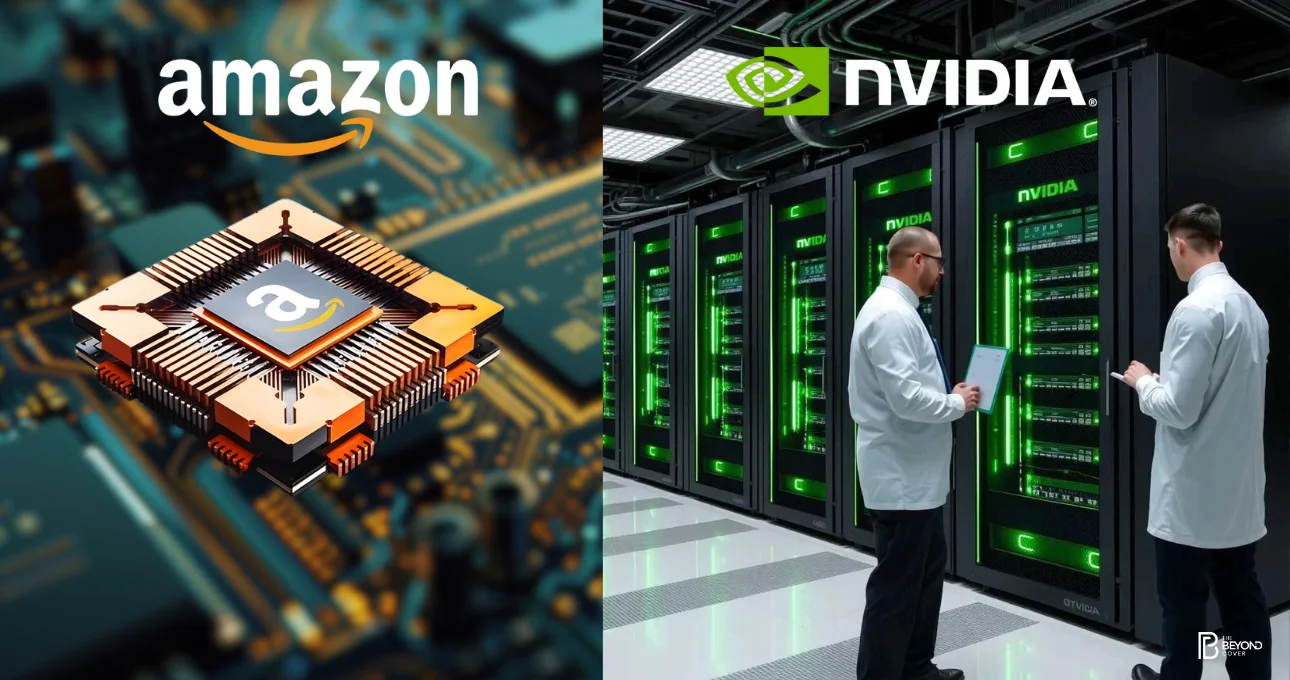
Amazon is intensifying competition in the artificial intelligence hardware space, adding fresh pressure on Nvidia’s long-standing dominance in data center AI chips. Through Amazon Web Services (AWS), the tech giant is aggressively expanding its lineup of custom AI chips, positioning them as cost-effective and scalable alternatives to Nvidia’s industry-leading GPUs.
This strategic push signals a broader shift in how hyperscalers are approaching AI infrastructure—favoring in-house silicon design to reduce dependence on external chip suppliers.
Amazon’s Custom AI Chip Strategy Explained
At the center of Amazon’s effort are its custom-built AI chips, designed specifically for cloud workloads. AWS has developed chips optimized for machine learning training and inference, aiming to deliver high performance at lower cost for enterprise customers.
Unlike general-purpose GPUs, Amazon’s custom AI chips are tailored to AWS services, allowing tighter integration with its cloud ecosystem. This approach helps customers build and deploy AI models more efficiently while reducing infrastructure expenses—an increasingly important factor as AI workloads scale rapidly.
By offering these chips as part of its cloud services, Amazon is encouraging businesses to rely less on Nvidia-powered instances and more on AWS-native AI infrastructure.
Nvidia’s Data Center Stronghold Under Pressure
Nvidia has long been the dominant force in data center AI computing, with its GPUs forming the backbone of generative AI, large language models, and high-performance computing workloads. Demand for Nvidia’s AI accelerators has surged as companies race to deploy AI at scale.
However, Amazon’s custom AI chip push introduces a credible alternative—especially for customers already deeply embedded in the AWS ecosystem. While Nvidia continues to lead in cutting-edge AI performance, hyperscalers like Amazon are increasingly prioritizing cost control, energy efficiency, and supply stability.
This trend is gradually reshaping the competitive landscape, even if Nvidia’s technological edge remains strong.
Why Hyperscalers Are Building Their Own AI Chips
Amazon is not alone in this strategy. Major cloud providers are investing heavily in custom silicon to gain more control over performance, pricing, and availability. For Amazon, the benefits are clear:
- Reduced reliance on third-party chipmakers
- Better optimization for cloud-specific AI workloads
- Improved margins on cloud services
- Greater flexibility amid global chip supply constraints
As AI adoption grows, these advantages become increasingly valuable, especially as data center costs rise.
What This Means for AI Customers
For businesses deploying AI through AWS, Amazon’s custom AI chips offer a compelling proposition. Customers can access AI acceleration at potentially lower costs, while still benefiting from AWS’s mature cloud tools and global infrastructure.
That said, Nvidia’s GPUs remain essential for many advanced AI use cases, particularly those requiring maximum performance or compatibility with existing AI frameworks. As a result, most enterprises are expected to adopt a hybrid approach, using both Nvidia-powered and custom-chip-based instances depending on workload needs.
The Future of the AI Chip Market
Amazon’s growing confidence in its custom AI chips highlights a broader industry shift toward diversified AI hardware ecosystems. While Nvidia is unlikely to lose its leadership position overnight, increased competition from hyperscalers is changing the dynamics of the AI chip market.
Over time, this could lead to more innovation, better pricing, and greater choice for customers building AI-driven applications.
Conclusion: Rising Competition Redefines Data Center AI
Amazon’s custom AI chip push represents more than just an internal optimization—it’s a strategic move that adds real pressure on Nvidia’s data center stronghold. As AI demand continues to surge, the battle for control over AI infrastructure is intensifying.
While Nvidia remains the benchmark for AI acceleration, Amazon’s approach underscores a key reality of the AI era: the future of data center computing will not belong to a single chipmaker.