










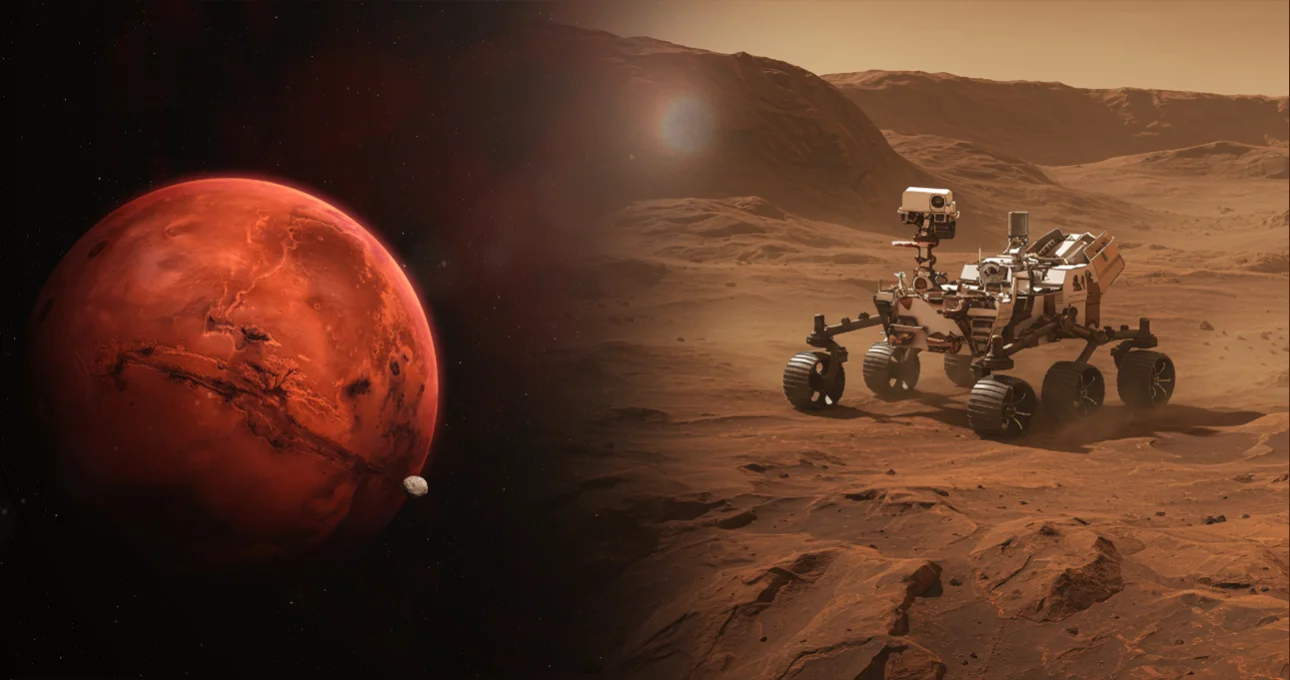
In a breakthrough that pushes the boundaries of space technology, Google DeepMind has unveiled “AlphaRover,” an autonomous AI system designed to navigate Mars-like terrains using self-learning robotics. The new system represents a major milestone in combining artificial intelligence with space exploration—one that could define how future rovers survive, adapt, and explore hostile planetary landscapes.
For decades, Mars rovers have depended heavily on instructions transmitted from Earth. These commands, delayed due to vast interplanetary distances, limit the rover’s ability to react instantly to unexpected conditions. AlphaRover aims to change this paradigm by giving robots the ability to think, learn, and make complex navigation decisions on their own.
What Is AlphaRover?
AlphaRover is a next-generation autonomous navigation model built using DeepMind’s advanced reinforcement learning frameworks. The system trains on high-fidelity simulations of Martian surfaces—complete with rocky terrain, unpredictable slopes, dust storms, and crater edges—to learn optimal navigation strategies.
Key capabilities include:
- Self-learning terrain adaptation
- Real-time obstacle detection and avoidance
- Energy-efficient route planning
- Slip prediction on sand and loose surfaces
- Survival-driven decision-making during emergencies
DeepMind states that the AI can recognize patterns and terrain types faster than existing rover navigation systems, enabling split-second decisions without waiting for human intervention.
Why Space Agencies Are Excited
NASA, ESA, and ISRO have all been exploring AI-driven technologies for space missions, but autonomous reasoning has long been a missing piece. Existing rover technology relies on slow, rule-based systems that cannot rapidly adapt to dynamic environments.
AlphaRover changes that by offering:
1. Faster Exploration With Less Risk
The AI can maneuver complex areas—such as rocky cliffs or deep craters—that current rovers avoid due to high risk.
2. Improved Efficiency
By optimizing energy use and route planning, AlphaRover can dramatically extend mission life.
3. Real-Time Decision Making
The rover does not need to wait for Earth-to-Mars commands, allowing 24/7 operations.
4. Lower Mission Costs
With fewer human interventions, agencies can allocate resources to broader research tasks.
A Major Leap for Autonomous Robotics
DeepMind highlights that AlphaRover uses “learning by exploration,” similar to how children learn to walk—trial, error, and adaptation. Through millions of simulated scenarios, the AI builds a deep internal understanding of terrain physics, friction, slope dynamics, and hazards.
What sets AlphaRover apart is its ability to continually learn during missions, evolving and improving based on real planetary data. This means future rovers will not just execute tasks—they will grow smarter with every kilometer.
Future Applications: From Mars to the Moon and Beyond
Space agencies are already considering AlphaRover for:
- Mars sample-return missions
- Lunar surface mapping
- Asteroid mining exploration
- Search for water and mineral deposits
- Hazard detection on unexplored terrain
The AI could also be integrated into robotic swarms, where multiple autonomous robots explore in coordinated patterns.
Final Thoughts
The launch of AlphaRover marks a defining moment in space technology—a shift from remote-controlled exploration to AI-powered planetary independence. With DeepMind’s self-learning robotics, future missions may run faster, safer, and farther than ever before.