









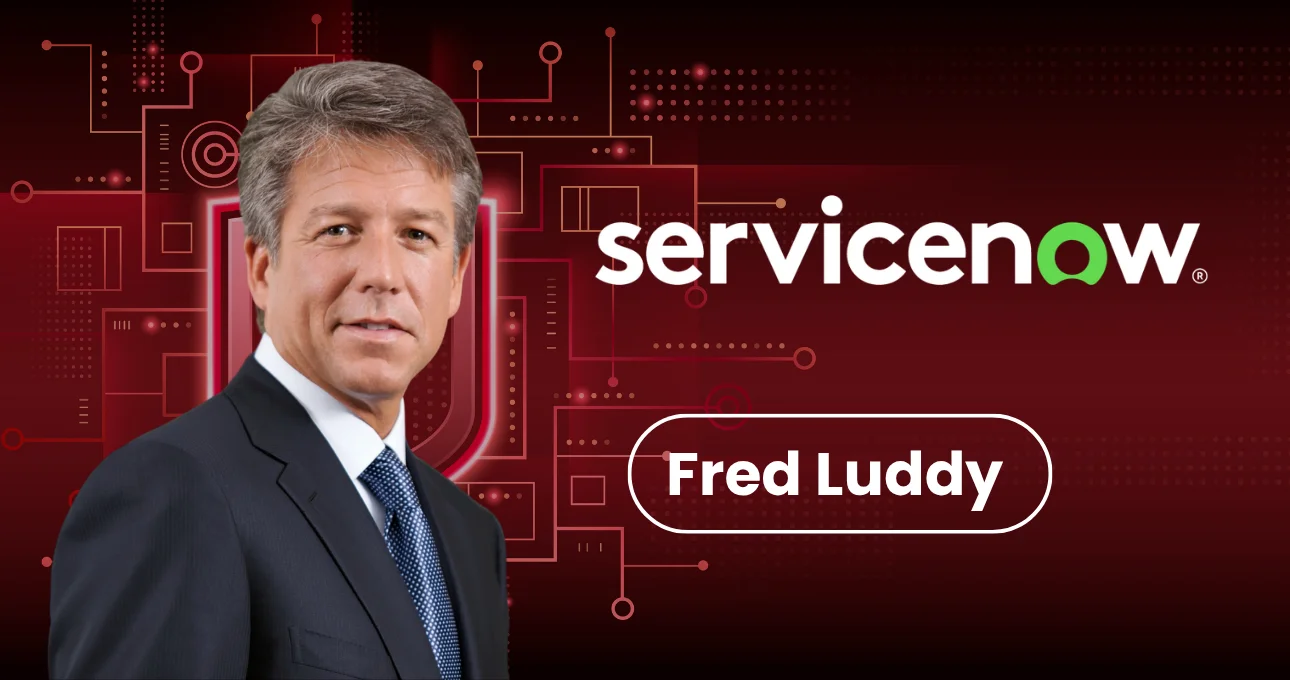
In a world where regulatory complexity is accelerating from GDPR and SOX to India’s DPDP Act and RBI cybersecurity mandates– enterprises are under immense pressure to gain real-time visibility into risk. Nearly 40% of CISOs cite risk visibility as their top challenge. Against this backdrop, ServiceNow has emerged as a category leader with its Governance, Risk, and Compliance (GRC) platform, built on the powerful Now Platform.
Recognized as a Leader in the Forrester Wave™ for GRC (Q4 2023, with continued validation into 2026), ServiceNow achieved the highest score in Strategy (5.0/5)—cementing its dominance in AI-driven enterprise risk management. Today, the platform supports 85% of Fortune 500 companies, delivering unified risk operations across Integrated Risk Management (IRM), Third-Party Risk Management (TPRM), Policy & Compliance, and Audit Management.
Visionary Founder: The Workflow Pioneer
ServiceNow was founded in 2004 by Fred Luddy, a legendary figure often referred to as the “Father of IT Service Management.”
Before ServiceNow, Luddy built and exited two major enterprise software companies:
- Peregrine Systems (founded in 1993, ~$500M exit)
- Remedy Corporation (later acquired by BMC Software)
Luddy identified a major gap in enterprise IT: fragmented tools that lacked unified workflows. His vision was to create a cloud-native platform that automates workflows across the enterprise– a concept that would later evolve into the Now Platform.
Originally launched as GlideSoft in San Diego, the company rebranded to ServiceNow in 2006, focusing on ITIL-based workflow automation.
Transformative Milestones: From ITSM to GRC Leader
ServiceNow’s journey reflects a steady expansion from IT service management to enterprise-wide workflow automation.
Timeline of Key Milestones
Year | Milestone | Impact |
2004 | GlideSoft founded | Cloud ITSM vision begins |
2006 | First paying customer | Platform validation |
2007 | ITIL workflows launched | Disrupts legacy vendors |
2012 | NYSE IPO ($210M raised) | Scales globally |
2015 | Expansion into HR & Customer Service | Cross-enterprise workflows |
2018 | Launch of Now Platform (low-code) | Democratizes development |
2021 | Vancouver release; AI at scale | ~$6B ARR |
2023 | Forrester GRC Leader | Highest Strategy score |
2025 | $12.6B revenue (+22%) | AI Agent Fabric introduced |
2026 | Xanadu release | IRM maturity; 8,100 customers |
GRC-Specific Innovation
- Vancouver Release (2023): Unified IRM architecture across risk, compliance, and audit
- Washington DC Release (2024): AI-powered risk scoring and automation
- Xanadu Release (2026): Enhanced IRM maturity and AI-driven orchestration
By 2026, ServiceNow achieved:
- $162B market capitalization
- 8,100+ enterprise customers
- GRC contributing significantly (~15%) to platform revenue
Now Platform GRC Architecture: Unified Risk Intelligence
ServiceNow’s GRC strength lies in its single data model, which unifies risk operations across the enterprise.
Core GRC Workflow
Risk Intelligence → Continuous Monitoring → Automated Controls → AI Remediation → Executive Dashboards → Regulatory Reporting
This unified architecture eliminates silos and enables real-time visibility across all risk domains.
Integrated Risk Management (IRM) Modules
- Policy & Compliance Management: Automates policy lifecycle and regulatory alignment
- Business Continuity Management (BCM): Scenario planning and resilience modeling
- Enterprise Risk Management (ERM): Risk heat maps and Key Risk Indicators (KRIs)
- Third-Party Risk Management (TPRM): Vendor risk assessments and monitoring
- Audit Management: Automated workflows for SOX, ISO, and internal audits
AI Agent Fabric: Automating 80% of Risk Workflows
A defining innovation in ServiceNow’s GRC platform is its AI Agent Fabric, introduced in 2025. This layer automates up to 80% of manual risk and compliance workflows, transforming how organizations manage risk.
AI Capabilities
- Risk Agent: Predictive analytics for KRIs
- Compliance Agent: Automated control testing
- Audit Agent: Evidence collection and validation
Now Assist for GRC (Natural Language Queries)
Examples include:
- “Show SOX controls failing for more than 30 days”
- “Assess third-party cyber risk by geography”
- “Generate RBI compliance report for Q1”
- “Prioritize KRIs by business impact”
This natural language interface dramatically improves accessibility for non-technical stakeholders.
Forrester Wave Leadership: 2023 to 2026
ServiceNow’s GRC platform achieved top-tier scores across all major categories:
Criteria | Score |
Strategy | 5.0/5 (Highest) |
Innovation | 5.0/5 |
Workflow Automation | 5.0/5 |
Risk Monitoring | Leader |
AI Capabilities | Broadest roadmap |
Forrester Quote:
“Automated GRC backed by comprehensive AI innovation plans.”
Frictionless GRC Economics and ROI
ServiceNow’s pricing and ROI model reinforces its enterprise appeal:
Edition | Annual Pricing | Key Modules |
Professional | ~$50/user | Core IRM |
Enterprise | ~$100/user | Full TPRM + Audit |
Strategic Portfolio | Custom | AI + Advanced Analytics |
Proven ROI
- 450% ROI (Forrester TEI study)
- 60% automation of risk processes
- $5.2M savings over 3 years
Real-World Impact: India and Global Use Cases
ServiceNow’s GRC platform has seen strong adoption in India, supported by data centers in Hyderabad and Mumbai.
India Compliance Capabilities
- DPDP Act privacy workflows
- RBI cybersecurity compliance
- SOX-aligned reporting
- SEBI-driven TPRM frameworks
Enterprise Deployments
- ICICI Bank
- HDFC Bank
- Tata Consultancy Services
Impact Metrics
- 75% reduction in audit cycles (global banking)
- 75% reduction in manual audit effort (India example: HDFC)
- Automation of 500+ vendor risk assessments (manufacturing)
Key CXOs and Senior Leadership
Bill McDermott – Chairman & CEO
A former SAP executive, McDermott has driven ServiceNow’s hypergrowth, tripling revenue during his tenure.
Gina Mastantuono – President & CFO
Leads financial strategy and scaling, helping drive revenue beyond $12B.
Jacqui Canney – Chief People & AI Enablement Officer
Focuses on talent, culture, and ethical AI adoption in GRC.
Chris Bedi – Chief Customer Officer & AI Advisor
Leads customer success and AI strategy alignment.
Russ Elmer – Special Counsel
Drives regulatory and compliance strategy.
Paul Fipps – President, Global Customer Operations
Oversees global delivery and enterprise adoption.
Gaurav Rewari – EVP & GM, Data & Analytics
Leads AI-driven risk intelligence initiatives.
GRC Product and Domain Leaders
Travis Darrow – Director, Digital Technology GRC
Drives platform innovation.
Aradhana Singh – ServiceNow GRC Specialist
Expert in TPRM and IRM implementations.
Harsharanjeet Kaur – IRM Consultant (Accenture)
Leads India-based GRC delivery programs.
Unified Risk Operations Center
ServiceNow enables a single workspace architecture that integrates:
IRM → TPRM → Policy → Audit → Vendor Management → BCM → Operational Risk
This unified model allows enterprises to manage all risk functions in one place, eliminating fragmentation and improving efficiency.
2026 Xanadu Roadmap: The Future of GRC
ServiceNow’s forward-looking roadmap includes:
- Quantum-safe risk modeling
- AI Agent Marketplace for GRC apps
- Real-time supply chain risk intelligence
- Regulatory Intelligence Copilot
These innovations position ServiceNow at the forefront of next-generation risk management.
Conclusion: The Platform-First GRC Leader
From Fred Luddy’s original vision of workflow automation to today’s AI-powered enterprise platform, ServiceNow has built a dominant position in the GRC market.
Its key differentiators include:
- Unified platform architecture (no integration complexity)
- Deep AI automation (80% workflow reduction)
- Strong regulatory alignment (global + India-specific)
- Proven ROI and enterprise scalability
For Fortune 500 organizations, ServiceNow GRC is more than a compliance tool– it is a strategic risk intelligence platform. It empowers auditors with evidence, CISOs with insights, and executives with real-time dashboards.
As regulatory demands intensify and cyber risks evolve, ServiceNow’s AI-driven workflows ensure that when regulators call, enterprises are not just ready– they are already ahead.