









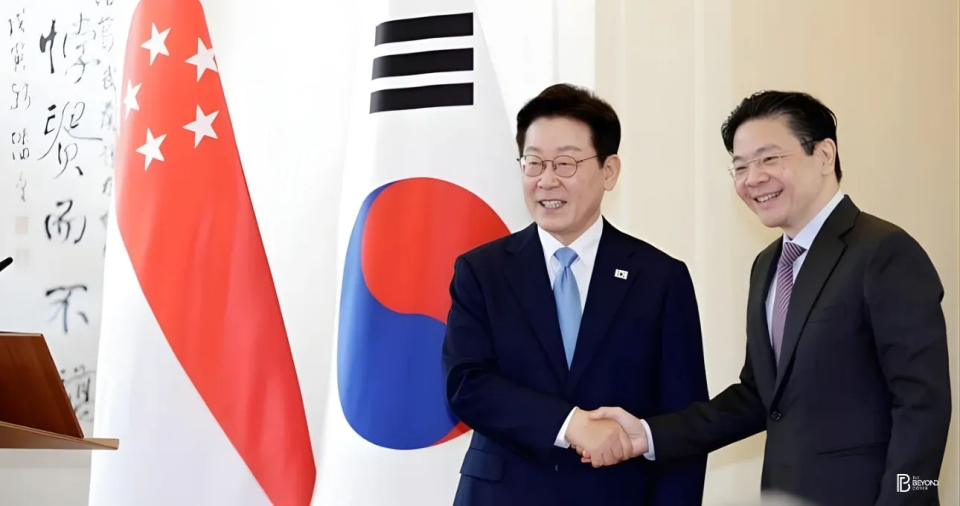
South Korea and Singapore have taken a major step toward shaping Asia’s technology landscape, placing artificial intelligence at the centre of their economic partnership. On March 2, 2026, South Korean President Lee Jae-myung and Singaporean Prime Minister Lawrence Wong met in Singapore to strengthen bilateral ties, expand trade and launch new collaborations across next-generation technologies.
The summit signals more than diplomatic engagement—it reflects a shared strategy to accelerate innovation, secure supply chains and create new growth opportunities in the global AI race.
Upgrading Trade and Launching High-Impact Tech Partnerships
One of the key outcomes of the meeting was the decision to begin upgrading the 2006 Free Trade Agreement (FTA) between the two nations. The revised framework is expected to improve the movement of:
- Semiconductors
- AI infrastructure and tools
- Data centre investments
- Digital services
Alongside the trade upgrade, five major Memorandums of Understanding (MOUs) were signed, covering:
- Artificial intelligence cooperation
- Small modular reactors (SMRs) for clean energy
- Quantum technology
- Space and satellite development
- Digital and innovation ecosystems
These agreements combine South Korea’s strength in advanced manufacturing and semiconductor production with Singapore’s leadership in digital governance, finance and data infrastructure.
A Complementary Tech Partnership
The collaboration works because both countries bring different but highly compatible capabilities.
South Korea contributes:
- Global semiconductor manufacturing capacity
- Large-scale industrial infrastructure
- Deep expertise in hardware innovation
Singapore offers:
- Strong regulatory and AI governance frameworks
- Its position as Southeast Asia’s leading data and finance hub
- A global investment network
During the visit, President Lee also participated in the AI Connect Summit, met Singapore’s President Tharman Shanmugaratnam, and engaged with business leaders to accelerate industry-level cooperation.
Investment Flows and Startup Opportunities
The summit also unlocked new financial partnerships. Singapore’s investment firms Temasek and Seviora signed agreements with the Korea Development Bank, opening the door for:
- Joint technology ventures
- Cross-border startup funding
- Collaborative R&D in emerging technologies
For startups and research institutions, this creates access to shared talent, joint laboratories and larger regional markets.
Why This Alliance Matters in the Global AI Race
The timing is significant. As geopolitical tensions reshape technology supply chains, countries are increasingly forming strategic partnerships to reduce dependence on single markets.
This alliance helps:
- South Korea diversify beyond traditional export destinations
- Singapore strengthen its role as a neutral, innovation-driven hub
- Both countries compete more effectively with larger tech blocs
The cooperation on SMRs also supports climate goals by enabling cleaner energy for power-intensive AI data centres.
What It Means for India and the Wider Asian Market
India has been closely involved in recent multilateral AI discussions with both nations, particularly through global initiatives focused on human-centric AI.
A stronger South Korea–Singapore tech corridor could lead to:
- Faster rollout of advanced consumer devices
- More affordable AI-powered products
- Increased investment and job opportunities across Asia
- Greater collaboration in research and digital infrastructure
For Indian consumers and developers, the ripple effect may be seen in smarter devices, improved platforms and deeper regional innovation networks.
The Road Ahead
By mid-2026, progress on the upgraded FTA and the newly signed technology agreements is expected to translate into tangible industry collaborations.
This partnership demonstrates a broader shift: the future of AI will not be shaped by individual nations alone, but by strategic, cross-border ecosystems that combine manufacturing strength, capital, governance and talent.