









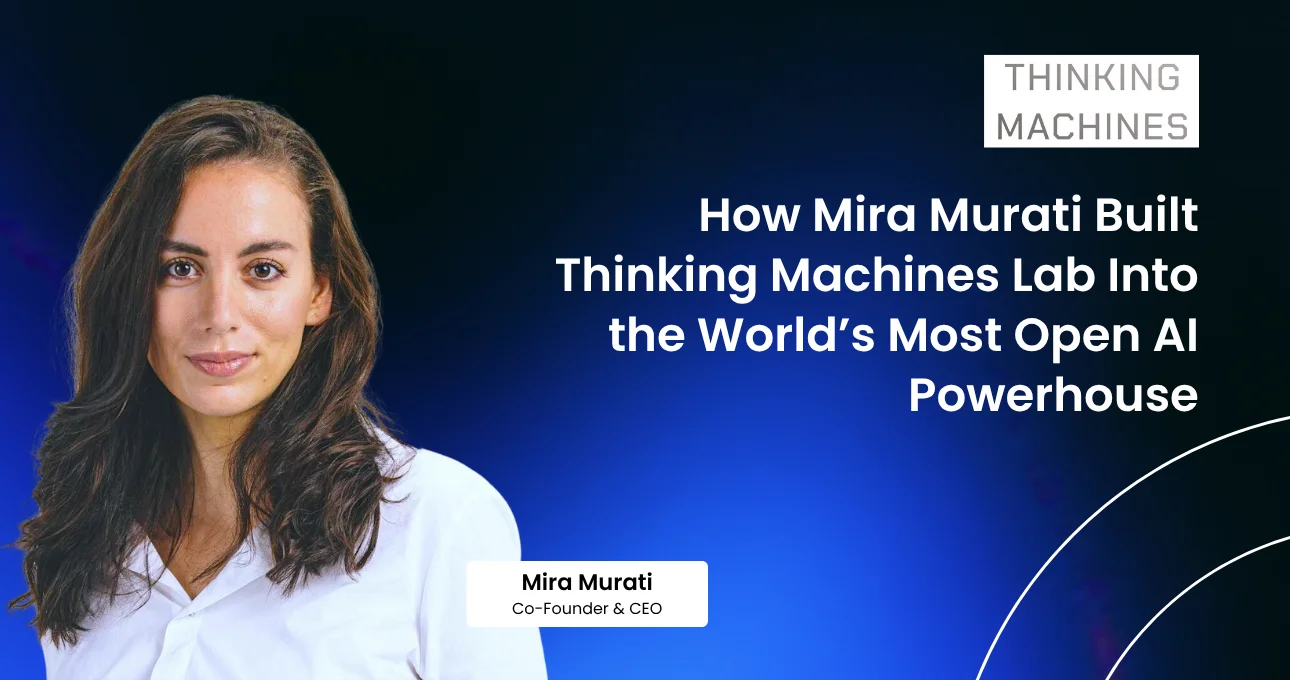
When Mira Murati walked away from one of the most powerful seats in Silicon Valley—CTO and interim CEO of OpenAI—most expected her to join another tech giant or retreat into a quiet advisory role. Instead, she did the opposite. She built a new kind of AI company from the ground up—Thinking Machines Lab—with a mission bold enough to rattle an industry dominated by trillion-dollar players.
Founded in February 2025, the company didn’t begin as a traditional startup. It began as a declaration: that advanced AI should not belong only to those who can afford massive compute, elite talent, or secretive research pipelines. Murati envisioned a world where powerful models were not mysterious black boxes—but tools that anyone, from students to scientists to small companies, could adapt, customize, and fully understand.
That vision found instant resonance. Within months, Thinking Machines Lab closed a jaw-dropping $2 billion seed round, attracting global attention and a handpicked team of researchers from Meta, Google, Mistral, OpenAI, and top academic labs. The message was clear: people weren’t just betting on the company—they were betting on Murati.
What makes her leadership magnetic is the mix of calm technical mastery and rebellious clarity. She had already helped bring products like ChatGPT, DALL-E, and Sora into the world—tools that reshaped how millions interact with creativity, work, and information. But she also saw the limitations: opacity, high barriers to entry, and a widening gap between research institutions and everyday innovators.
Thinking Machines Lab is her answer to that problem.
In October 2025, the lab launched Tinker, a flagship product designed to make customizing frontier models as intuitive as drag-and-drop editing. Want to fine-tune Llama for legal research? Adapt Qwen for biomedical discovery? Build your own multimodal agent with zero ML engineering? Tinker was built precisely for this. It strips away the traditional complexity of training large models, placing experimentation in the hands of people who previously only dreamed of it.
But Murati’s ambitions stretch far beyond tools. She’s building a culture of scientific openness at a time when AI labs are locking away more than they reveal. Thinking Machines Lab publishes aggressively, open-sources its frameworks, and engages with researchers worldwide—not because it’s trendy, but because Murati sees transparency as the only path to safe and meaningful progress.
Her governance structure reinforces this independence. With strong voting control, she ensures the company cannot be steered away from its public benefit mandate—not by investors, not by competitors, not by fleeting market pressures.
In a sector driven by speed and secrecy, Murati stands out for her unusual combination of idealism and precision. She champions diversity in research teams. She pushes for AI evaluations rooted in societal impact, not just benchmarks. And she remains one of the rare women leading an AI company capable of standing shoulder-to-shoulder with OpenAI, Anthropic, and Google DeepMind.
Mira Murati’s work signals a new era in the AI landscape—one defined not by scale alone, but by access, clarity, and shared progress. As AI becomes inseparable from everyday life, her mission at Thinking Machines Lab may well shape not just the next generation of AI systems, but the next generation of AI thinkers.